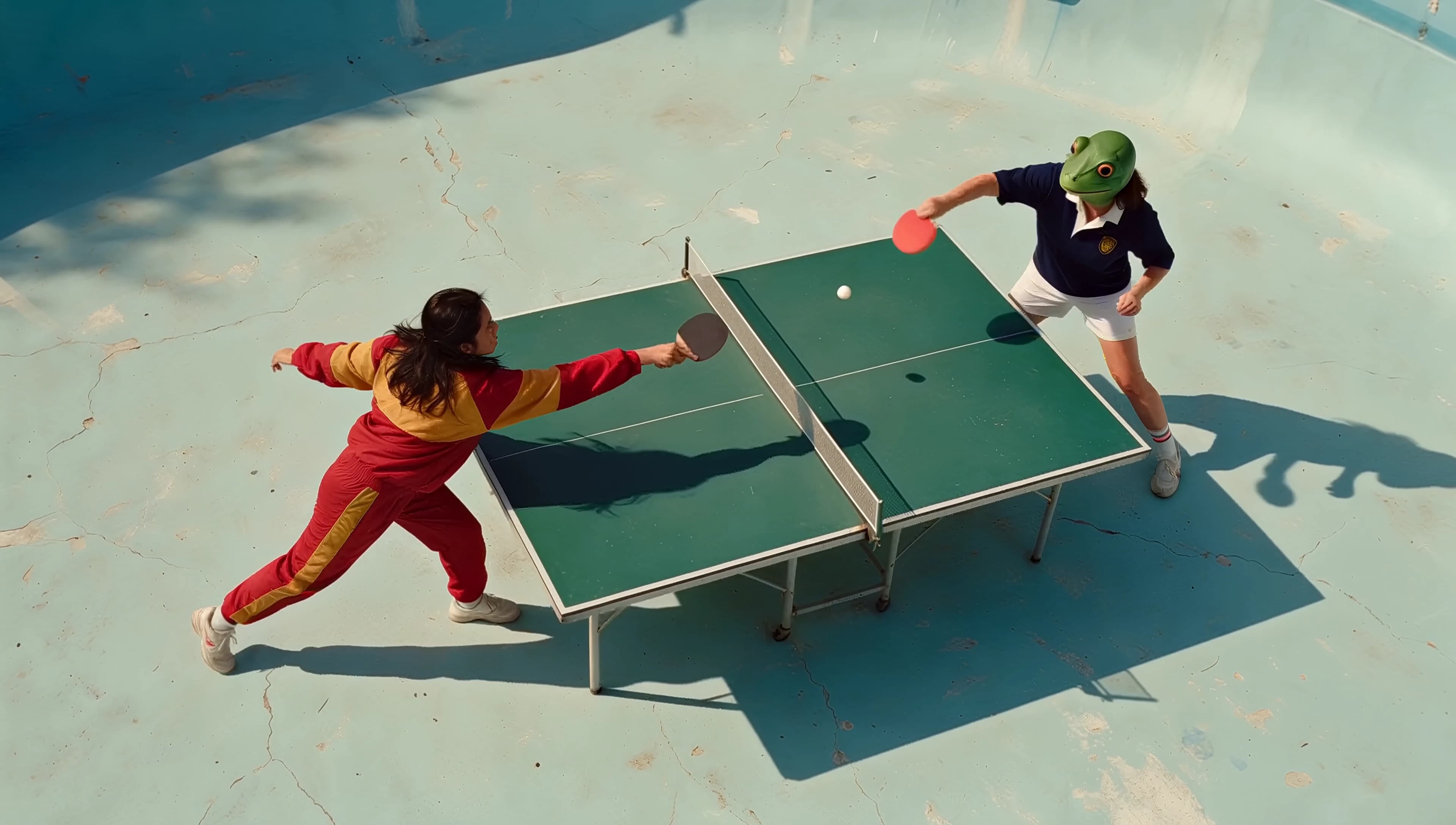
Pika H3 Flex
Our faster-than-realtime model.
Built for professional iteration
Pika H3 Flex is a post-trained H3 model, designed to give professional creators the flexibility and speed to explore with precision. It maintains the quality creators need, while generating faster than real-time in almost every configuration — 1.8x faster than H3Max.*
Optimized for greater control, it offers resolutions up to 4K, up to 12 reference inputs, and precision editing through reference and prompt. It also introduces exportable audio stems, to isolate and refine any facet of the soundscape.
Speed and price
1.8x
Faster
than H3Max
Up to
80%
Cheaper
than H3Max
*On average, across matched t2v, i2v, and r2v comparisons. DiT time, not guaranteed end-to-end latency.
ITERATE FASTER THAN REAL-TIME
Pika H3 Flex can generate a 15 second clip in as little as 7 seconds, for creation at the speed of thought.*
BUILT FOR TINKERING LIKE A PRO








Draft at 768p, finish at 4K
Explore ideas quickly at lower resolution, and upscale to 1080p, 2K, or 4K in finishing mode when you’re ready. Everything you love will be preserved, just ready for prime time.
Separate Audio Stems
Export up to 5 audio stems to isolate and refine any facet of a clip’s soundscape: Dialogue, Score, SFX, Foley, and Ambience
A FLEXIBLE PERFORMER
Pika H3 Flex excels at a wide variety of video types and genres.
Make it Move
Direct anything from orbits, to dollies, cranes, tracking shots, whip pans, macro moves, and changing lenses in natural language. Pika H3 Flex can handle it.
RANKED #7 IN VIDEO QUALITY
Pika H3 Flex is ranked #7 in video quality, above base H3, H3Max, and Seedance 2.5 on DesignArena’s text to video board. And it’s the highest ranked model with open weights.

Launch Promo
Get 15 free Pika H3 Flex generations per day
As a Pika API Club member, from October 29 to November 5th
PRICED TO PLAY
Text, image, and keyframe generation
Prices are charged per output-video second.
Draft-to-video finishes a 480p or 768p draft at 1080p, 2K, or 4K, keeping the same take and audio. You pay only the difference.
| Output | Regular Price | Launch Price |
|---|---|---|
| 480p | $0.02 / second | $0.01 / second |
| 768p | $0.04 / second | $0.02 / second |
| 1080p | $0.07 / second | $0.035 / second |
| 2k | $0.08 / second | $0.04 / second |
| 4k | $0.16 / second | $0.08 / second |
Reference to video
When a video reference is used, the same rate is charged for input-video seconds plus output-video seconds. Image and audio references are free of charge.
Draft-to-video finishes a 480p or 768p draft at 1080p, 2K, or 4K, keeping the same take and audio. You pay only the difference.
| Output | Regular Price | Launch Price |
|---|---|---|
| 480p | $0.06 / second | $0.03 / second |
| 768p | $0.12 / second | $0.06 / second |
| 1080p | $0.15 / second | $0.075 / second |
| 2k | $0.16 / second | $0.08 / second |
| 4k | $0.20 / second | $0.10 / second |
Audio Stems
An optional feature that generates separate audio stems along with any clip, including dialogue, score, SFX, Foley and ambience. Delivered as .wav files, this is ideal for fine-tuning sound in any editing software.
| Regular Price |
|---|
| $0.001 / second |
Prompt Rewriter (Independent API)
Automatically included and free of charge for Pika-hosted Pika H3 Flex.
If you’re hosting your own Pika H3 Flex, call our prompt rewriter API for prompt enhancement to greatly improve quality for your outputs.
| Regular Price |
|---|
| $0.02 / request |
OPEN WEIGHTS
In the spirit of creative iteration, we’re making Pika H3 Flex open source. Note that local inference will not necessarily match the optimized hosted API’s speed. Hardware, inference implementation, and optimization choices will all affect performance.



FULL MODEL SPECS
- Base model
- Post-trained on MiniMax H3
- Generation modes
- Text to video, first/last-frame image to video, multimodal reference to video, and prompt + reference-guided video editing
- Resolution
- 480p, 768p, 2K, 4K
- High-resolution output
- 2K and 4K are built into every Pika Flex endpoint. The request generates at 768p and upscales once inside the same job, preserving the generated image content.
- Duration
- 5–15 seconds in whole-second requests; output is rounded to the model’s frame grid
- Frame rate
- 24 fps
- Aspect ratios
- 21:9, 16:9, 3:2, 4:3, 5:4, 1:1, 4:5, 3:4, 2:3, 9:16, and 9:21
- Native audio
- Stereo, 32 kHz
- Integrated audio stems
- Every generation endpoint can return the video plus Dialogue, Score, SFX, Foley, and Ambience WAV files through
output_mode: audio-stems; stereo and mono separation are supported. - Reference limits
- 12 assets total: Up to 9 images, 3 videos, and 3 audio clips
- Reference duration
- Video and audio: 2–15 seconds each, with a maximum of 15 seconds combined per type
- Reference requirement
- At least one image or video in reference mode; audio-only reference requests are not supported
- Prompt length
- Up to 8,000 characters
- Seed control
- Supported
- Output format
- MP4 with H.264 video and AAC audio
- Open weights
- Hugging Face weights plus GitHub inference implementation
FAQ
Pika H3 Flex is our post-trained MiniMax H3 model, built for professional iteration. It generates faster than real time, works with up to 12 references, exports five separate audio stems, finishes at up to 4K, and ships with open weights.
It can generate a 15-second clip with synchronized audio at 768p in as little as seven seconds of transformer computation. We post-trained MiniMax H3 to generate in six steps instead of 50, then refined the faster model for quality and creative control.
No. Seven seconds measures transformer (DiT) computation for a 15-second 768p clip in a controlled benchmark, not total end-to-end API latency. Reference inputs, higher-resolution finishing, audio-stem separation, hardware, and service overhead affect completion time.
Up to 12 reference files in one generation, combining images, video, and audio: a sketch, a character sheet, a product photo, a moodboard, a voice sample, or a video of the movement you want. Tell Flex what each reference should contribute, then shape the result around your own direction.
Yes. Reference-guided editing lets you replace an outfit, a prop, or the world around your subject while directing Flex to preserve the performance and timing of the original footage.
Flex generates natively at 480p or 768p. Pika’s upsampler then brings the clip you choose to 1080p, 2K, or 4K, preserving the generated content as it adds detail, so you can explore at 768p and save the finishing pass for the version you love.
Every clip comes with synchronized stereo audio. Through the Pika API, you can also request five separate stems: Dialogue, Score, SFX, Foley, and Ambience. Turn down the music without turning down the conversation, or take each part into your edit and make the mix your own.
Flex’s generator adapters and inference code, covering text-to-video, first- and last-frame generation, and multimodal reference-to-video, with synchronized audio at 480p and 768p. The weights are on Hugging Face, and the code and setup instructions are on GitHub. The 1080p, 2K, and 4K upsampler, audio-stem separation, optional prompt enhancement, and accelerated serving stack are Pika-hosted features, and local performance depends on your hardware and setup.
Through the Pika API Club at dev.pika.art. Start with a prompt, an image, or your own references, generate a few directions, and refine the version you want to share.