Kling 4.0: Prompt Guide
Learn how to direct motion, camera and dialogue in Kling 4.0
Prompt Guide
Learn how to direct motion, camera and dialogue in Kling 4.0.
Overview
Kling 4.0 is Kuaishou's video model. It renders clips of 3 to 30 seconds at 720p or 1080p with native audio. On Omni Reference, prompt it from text alone or attach up to ten images and five clips as references; on Key Frames, attach up to ten stills in playback order and it animates through them. The Model switch also offers Kling 3.0: 3 to 15 seconds, up to 4K, a start frame and an end frame, and Audio you can turn off.
How to write the prompt
- Start with one sentence that says who or what is in the shot, where, doing what and in what mood. Add camera, timing and sound only where they change the result.
- Describe what the camera sees, not a mood. "Rain on the window, one desk lamp, steam rising off a mug" tells the model something; "cosy" does not.
- Say what you want to see instead of what to leave out. The two exceptions worth writing are "no subtitles" and "no music", because the model may add both by default.
- Give every attachment a job by its handle: @Image1 for the character's look, @Video1 for the camera path. An attachment with no job leaves the model to guess.
- For anything longer than one beat, write the action in playback order and give each beat its seconds: 0-3s, 3-6s, 6-10s.
- Call a camera move by its name: a tracking shot, a dolly in, an orbit, a crane up, a whip pan, a handheld close-up.
- Spell out how weight moves so bodies do not float or slide, and anchor hands to what they hold.
- Give the model texture to render: film grain, skin pores, fabric creases, condensation.
- Put sound on its own line: dialogue, ambience, effects and music. Kling 4.0 always renders audio; on Kling 3.0, turn Audio on.
- For speech, write the line in quotation marks in the language it should be spoken in, and describe the voice: age, tone, speed and emotion.
- On Key Frames, start from a clean, well-lit frame. @Start, @End and @Frame2 name the frames in the prompt.
Prompt structure
Attachment roles + Scene and look + Timed action + Audio
For one simple shot, a few sentences are enough. For a longer take or several shots, fill in each part:
@Image1 defines [the character or product]. Keep its [face, outfit, colours].
Follow the [camera path and pacing] of @Video1.

Scene and look: [place, light, texture, style].

0-3s: [what we see, the action, the emotion]
3-7s: [the camera move and the new detail]
7-10s: [the closing shot]

Audio: [dialogue], [ambience], [effects], [music, or "no music"].
Leave out the first two lines when you have no attachments.
Time one take beat by beat: Desert road
Label the prompt in blocks, time the action in seconds, and say outright what has to stay in frame.
Prompt
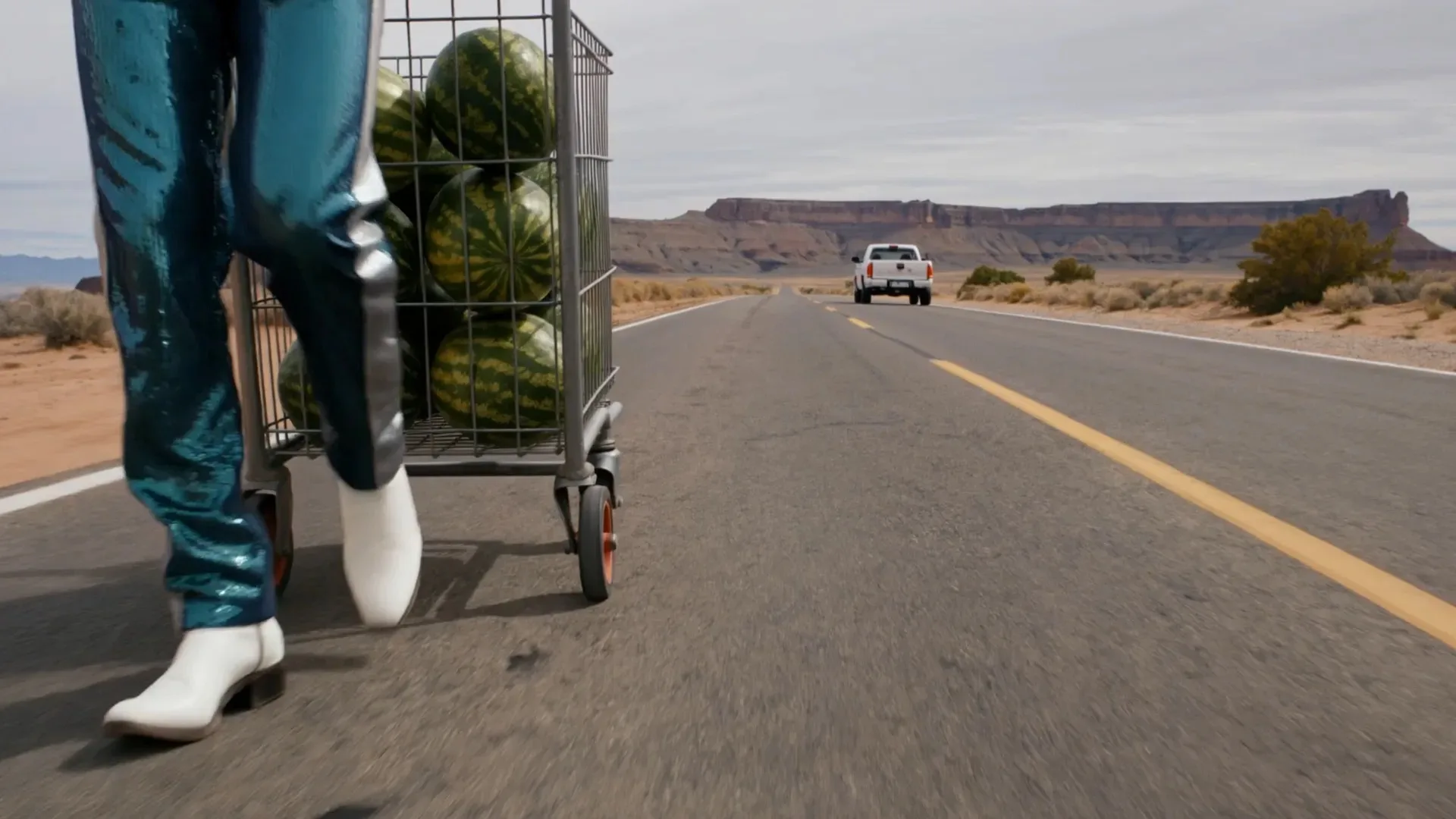
SCENE: wide 16:9, long-lens compression, camera low on the road. An empty dusty-pink desert road running straight to a distant flat-topped mesa under a soft overcast sky, scrub brush and pale sand either side. A Mexican man in his thirties with a moustache, in a cream cowboy hat, cream cowboy boots and a costumey emerald sequinned western suit with silver yoke trim, pushes a supermarket trolley heaped with whole striped watermelons along the road edge on the left third, walking with purpose. A single tiny white pickup truck far behind on the road. Palette: dusty rose desert against emerald sequins and watermelon green.
CAMERA: starts low and close at road level beside the trolley, then cranes up and pulls back high above the road in one continuous move, revealing the vast empty desert, the long road and the mesa, the man and his trolley becoming small. The high wide shot is framed to KEEP THE RUNAWAY WATERMELON IN FRAME the whole time.
ACTION / STORY: 0-3s he pushes the trolley forward, one wheel squeaking and wobbling, sequins glittering. 3-6s the trolley jolts over a crack and one watermelon tumbles off the top and rolls away ahead of him down the middle of the road; he stops and watches it go, deadpan. 6-10s he sighs and keeps pushing the trolley onward toward the mesa as the camera rises into the high wide shot. CRITICAL CONTINUITY: in the high wide shot the single runaway watermelon is clearly visible on the road - a distinct dark-green striped ball still rolling along the centre line well ahead of the man, kicking up a tiny puff of dust, a clear gap of road between it and the trolley, with the distant pickup truck further down the road beyond it. The watermelon never disappears from frame.
AUDIO: a squeaky wobbling trolley wheel, the hollow thump of the watermelon hitting asphalt and rolling, sequins rustling, dry desert wind, a far-off engine. Sparse twangy western guitar. No speech.
LOOK: a real 35mm film photograph in motion, never a 3D render. Soft, diffused, even, dimensional light; low-to-moderate contrast; colour true, soft but vibrant, never washed out; creamy highlight roll-off, a touch of warmth, light natural film grain, no HDR or sharpening. Skin with real photographic texture - pores, fine hairs, freckles. Anatomy correct: every person has exactly two arms and two hands with five fingers, no extra limbs. No visible text, logos or branding anywhere. SPEED IS CRITICAL: everything moves at normal real-time speed, like 24fps footage played back at 24fps - natural motion, NO slow motion.
Follow the subject with a named camera move: Roller skates
Set the framing first, then name the move and say how it ends. Here a Dutch tilt opens the shot and a fast low tracking shot lets the skater pull ahead and leave the frame.
Prompt
SCENE: wide 16:9, Dutch tilt rolled 20 degrees, camera low on the concrete. A multistorey car park ramp painted pale apricot with a cherry-red stripe running along the wall and a cherry-red band on the floor as leading lines, soft overcast white sky above. A Vietnamese man in his twenties with short black hair glides down the ramp on cherry-red quad roller skates with white socks, wearing a costumey cream ostrich-feather coat that streams behind him, bare legs, holding up a silver tray of four champagne coupes perfectly level in one hand, other arm out for balance. Nothing written on the walls. Palette: pale apricot and cream against deep cherry red.
CAMERA: a fast low tracking shot running alongside him down the ramp, keeping the Dutch tilt, matching his speed, then letting him pull ahead and out of frame on the left at the end.
ACTION / STORY: 0-3s he skates hard down the ramp, feathers whipping in the wind, tray steady. 3-5s one coupe wobbles and champagne sloshes to the rim; he dips into a deep low crouch and the glass settles without spilling a drop. 5-8s he rises and spins a full 360 on his skates, tray still perfectly level, coat fanning out. 8-10s he pushes off with a few strong strides and rolls away out of frame, a single cream feather left drifting down onto the concrete.
AUDIO: polyurethane skate wheels rumbling on concrete, echo of the car park, crystal coupes clinking, feathers rustling in wind, a punchy disco bassline. No speech.
LOOK: a real 35mm film photograph in motion, never a 3D render. Soft, diffused, even, dimensional light; low-to-moderate contrast; colour true, soft but vibrant, never washed out; creamy highlight roll-off, a touch of warmth, light natural film grain, no HDR or sharpening. Skin with real photographic texture - pores, fine hairs, freckles. Anatomy correct: every person has exactly two arms and two hands with five fingers, no extra limbs. No visible text, logos or branding anywhere. SPEED IS CRITICAL: everything moves at normal real-time speed, like 24fps footage played back at 24fps - natural motion, NO slow motion.
Cut one still into three shots: Wind over the field
Attach a still and ask for a multi-shot sequence with hard cuts. Give each shot its seconds, its camera move and its action, then say that every shot keeps the look of the first frame.
Prompt
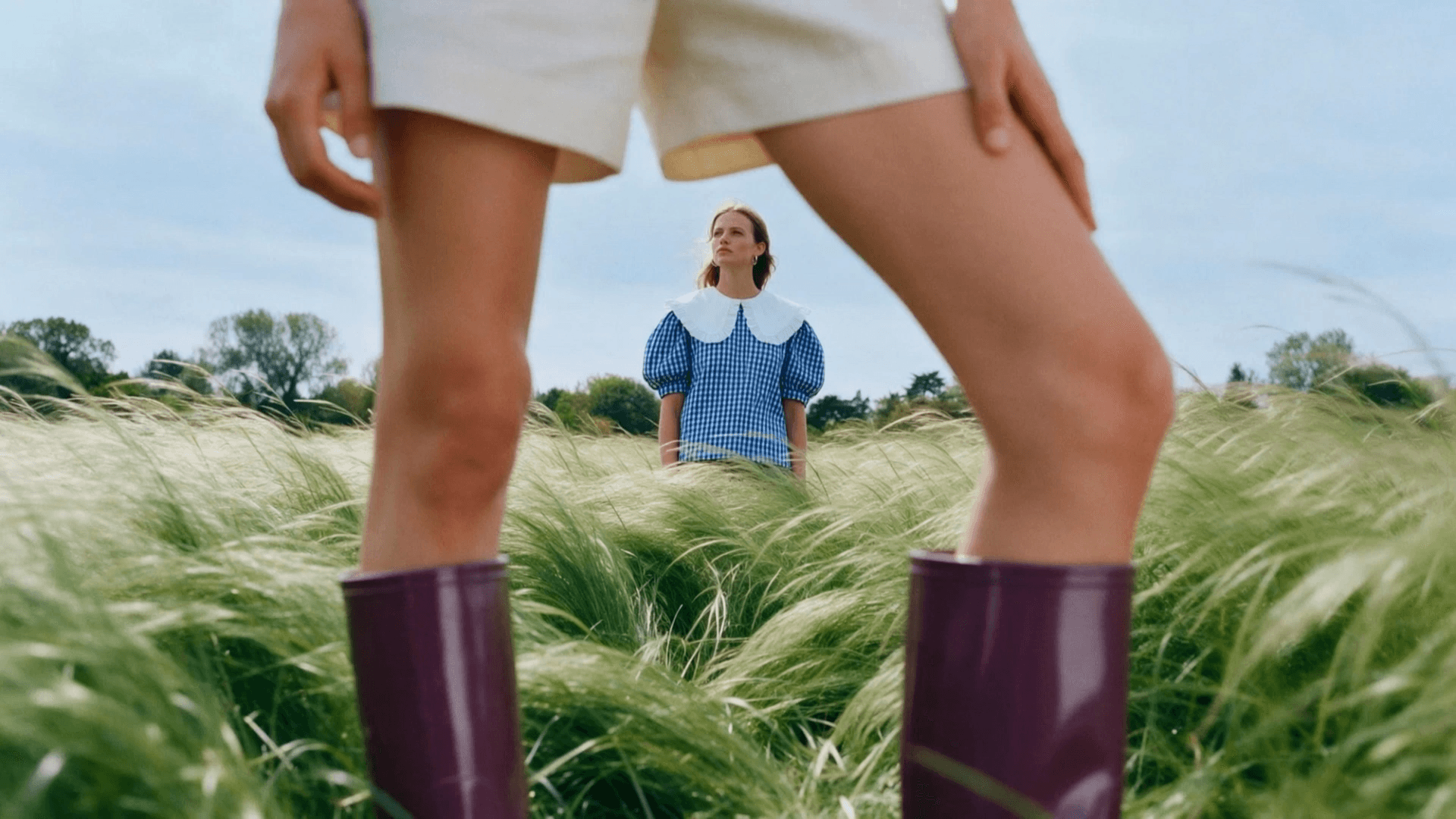
A multi-shot sequence of three shots with hard cuts, continuing from the first frame. Shot 1 (0-4s): low dolly push forward between the woman's legs in cream shorts and purple rubber boots, rack focus from the boots to the background; she steps aside out of frame. Shot 2 (4-7s): handheld medium close-up of the woman in the blue gingham blouse with the big white collar, wind whipping her hair; she turns from the horizon and looks straight into the lens. Shot 3 (7-10s): high wide drone shot rising above the windswept field of feathery grass, both women small in the waving grass. Sounds: strong wind through tall grass, rubber boots squeaking, skylarks, distant tractor. Every shot keeps the exact look of the first frame: same people, faces, wardrobe, colours, soft diffused light and 35mm film grain; real photographic texture, anatomy correct, no text or logos. The camera is never locked off. SOUND: natural, realistic on-set sound effects only - real room tone and the actual sounds of the actions - NO music, no score. SPEED IS CRITICAL: everything moves at normal real-time speed, like 24fps footage played back at 24fps - natural motion, NO slow motion.
Keep the sound real, with no score: Snake on the bed
List the sounds the action makes, then rule out music in plain words. This prompt names scales on linen, a pillow rustle and room tone, and closes with "NO music, no score".
Prompt
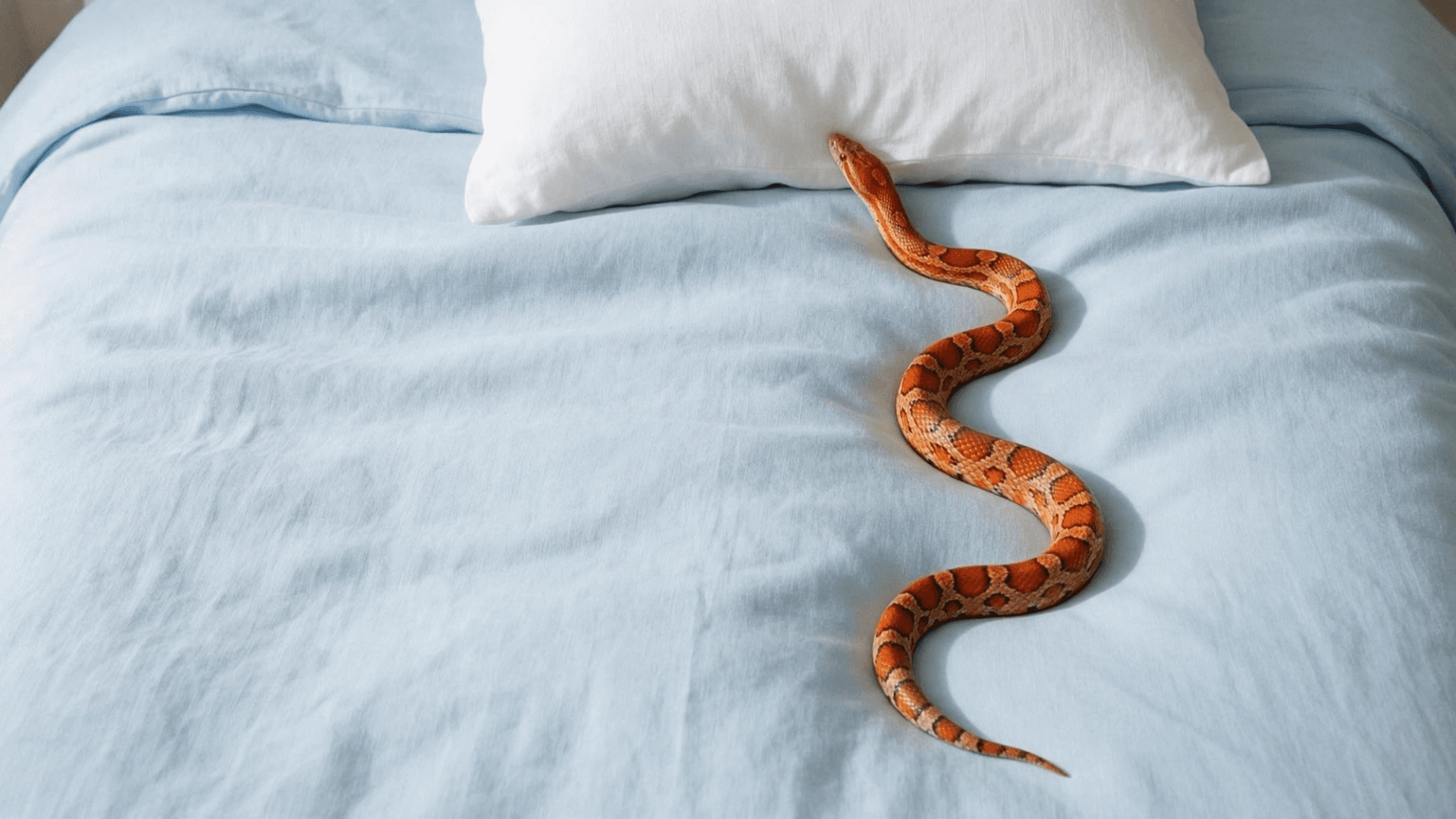
A multi-shot sequence of three shots with hard cuts, continuing from the first frame. Shot 1 (0-4s): overhead gimbal glide arcing around the bed - the orange corn snake slithers up the pale blue linen duvet and pushes its head under the white pillow, its body sliding in after it. Shot 2 (4-7s): low close-up at mattress level on the far side of the pillow, handheld - the pillow fabric bulges and ripples as the snake moves beneath it. Shot 3 (7-10s): crash zoom into an extreme close-up - the snake's head pokes out from under the pillow edge, tongue flicking. Sounds: scales sliding on linen, pillow rustle, quiet bedroom room tone with faint birds outside. Every shot keeps the exact look of the first frame: same people, faces, wardrobe, colours, soft diffused light and 35mm film grain; real photographic texture, anatomy correct, no text or logos. The camera is never locked off. SOUND: natural, realistic on-set sound effects only - real room tone and the actual sounds of the actions - NO music, no score. SPEED IS CRITICAL: everything moves at normal real-time speed, like 24fps footage played back at 24fps - natural motion, NO slow motion.
What to avoid
- Mood words in place of things the camera can see.
- A list of things to leave out. Describe the shot you want.
- Attachments with no stated job.
- More than four ideas in one shot.
- Long run-on sentences and stacked style keywords; they muddle the picture.