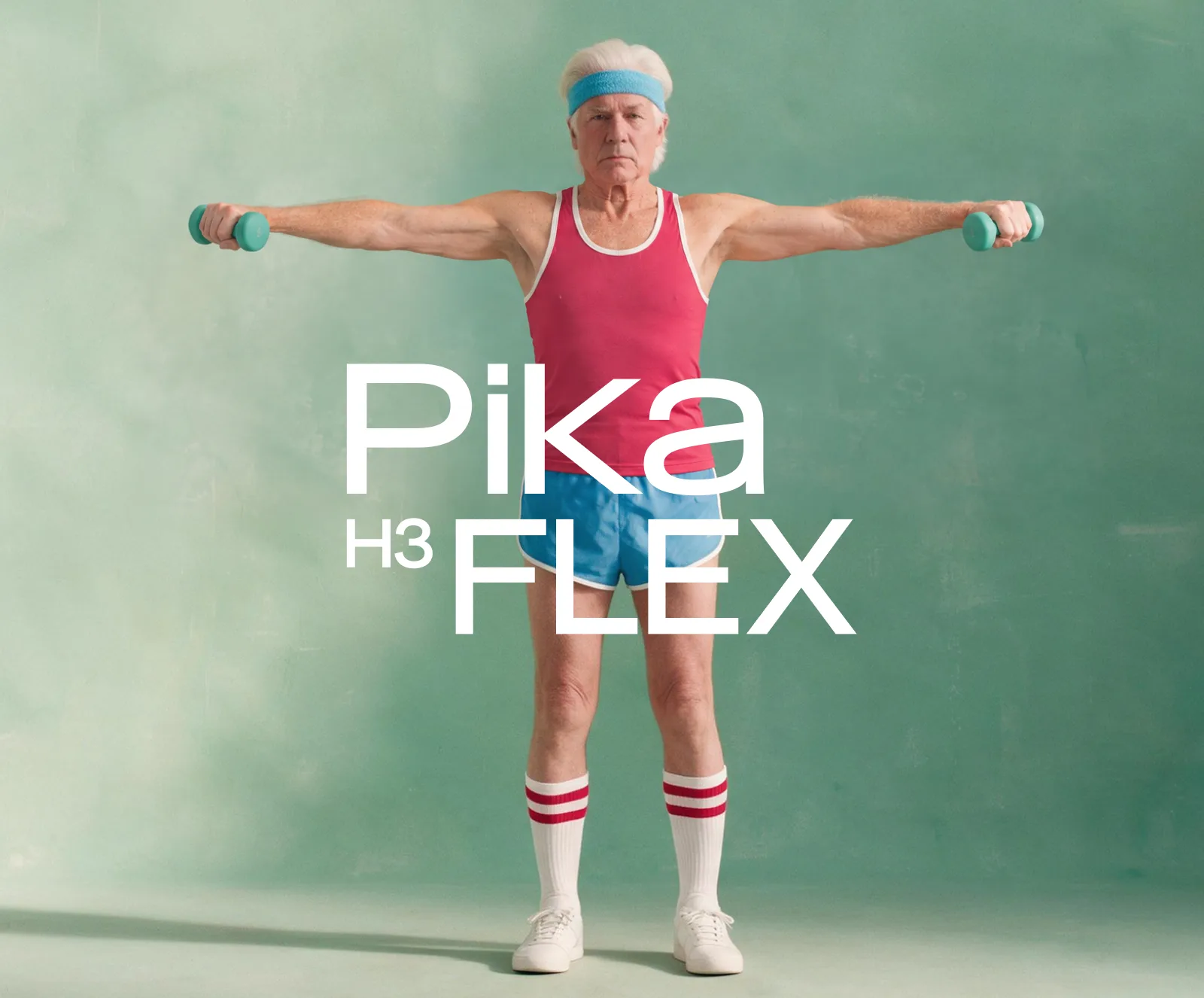
Pika H3 Flex Technical Deep Dive
Post-Training H3 to Six-NFE Omni-Generator
October 29, 2026Research
Today, we’re excited to launch Pika H3 Flex, an open-source omni video model family that ranks #1 among open-source text-to-video models and delivers real-time video generation. Post-trained by the Pika team on MiniMax H3, Pika H3 Flex combines advanced fine-tuning and reward-based optimization on an internally curated dataset selected for aesthetic quality. It delivers state-of-the-art results across visual and audio quality metrics and human preference evaluations, outperforming leading competitors by up to 91% while remaining competitively priced (see Table 1).
In our human evaluation study, Pika H3 Flex ranks #1 for human anatomy and artistic and aesthetic styles. Pika H3 Flex also supports a range of downstream editing tasks, including but not limited to style transfer, movement transfer, object replacement, character swap and targeted edits, opening up new possibilities for interactive content creation and rapid creative iteration.
Pika H3 Flex supports output resolutions from 480p to 4K and offers five separate, editable audio stems—dialogue, score, SFX, foley, and ambience—alongside the generated soundtrack, a first for a video model. Pika H3 Flex is available through our API, ComfyUI, and Diffusers, with model weights available on Hugging Face and code on GitHub. Pika also offers customized training services. To learn more, contact enterprise@pika.art.
Table 1. Pricing and capabilities of text/image-to-video models. Cost-cell colors progress from green (lowest) to red (highest). Real-time refers to generation latency below the output clip duration. 4K denotes output resolution availability.
| Model | Starting cost (USD/output-s) | Real-time | 4K output | Open weights | Audio stems |
|---|---|---|---|---|---|
| Pika H3 Flex | $0.01 | ✅ | ✅ | ✅ | ✅ |
| HeyGen Speed | $0.01 | Not disclosed | ❌ | ❌ | ❌ |
| HeyGen Quality | $0.01 | Not disclosed | ❌ | ❌ | ❌ |
| HeyGen Ultra | $0.01 | Not disclosed | ❌ | ❌ | ❌ |
| MiniMax H3 | $0.08 | ❌ | ❌ | ✅ | ❌ |
| Fal H3 Max | $0.0325 | ✅ | ❌ | ❌ | ❌ |
| Fal H3 Turbo | $0.01625 | ✅ | ❌ | ❌ | ❌ |
| Seedance 2.5 | $0.103 | ❌ | ❌ | ❌ | ❌ |
| FLUX 3 Video | $0.06 | ❌ | ✅ | ❌ | ❌ |
| Gemini Omni 1.1 Flash | $0.101 | ❌ | ✅ | ❌ | ❌ |
| Wan 3.0 | $0.03 | ❌ | ❌ | ❌ | ❌ |
Table 2. Reference-to-video pricing and capabilities. Pika H3 Flex offers competitive pricing while supporting all listed applications. ‡ Gemini Omni 1.1 Flash supports image and limited video references, but does not support uploaded audio references; audio embedded in reference videos is ignored (API documentation). * Seedance 2.5 and Wan3.0 adds video reference charge.
| Model | Starting cost (USD/s) | 4K output | Open weights | Multiple image, audio, video references | Uploaded-audio lip sync/redub |
|---|---|---|---|---|---|
| Pika H3 Flex | 0.03 | ✅ | ✅ | ✅ | ✅ |
| HeyGen Speed | 0.035 | ❌ | ❌ | ✅ | ✅ |
| HeyGen Quality | 0.035 | ❌ | ❌ | ✅ | ✅ |
| HeyGen Ultra | 0.035 | ❌ | ❌ | ✅ | ✅ |
| MiniMax H3 | 0.08 | ❌ | ✅ | ✅ | ✅ |
| Fal H3 Max | 0.05 | ❌ | ❌ | ✅ | ✅ |
| Seedance 2.5 | 0.103 • 0.0615* | ❌ | ❌ | ✅ | ✅ |
| Gemini Omni 1.1 Flash | 0.101 | ✅ | ❌ | Limited; no uploaded audio‡ | ❌ |
| Wan 3.0 | 0.03 • 0.03* | ❌ | ❌ | ✅ | ✅ |
Showcases
Our showcases demonstrate Pika H3 Flex’s capabilities across text-, image-, and reference-conditioned video generation, including controlled camera motion, multi-shot generation, and composition from multiple references. Our model further demonstrates strong capabilities in downstream applications, including but not limited to motion transfer, object replacement, character swapping, and selective video editing. Its low latency and competitive pricing support rapid iteration from initial concept to high-resolution output, while its open-source availability enables flexible integration into creative workflows and experimentation with new applications.
Complex camera choreography
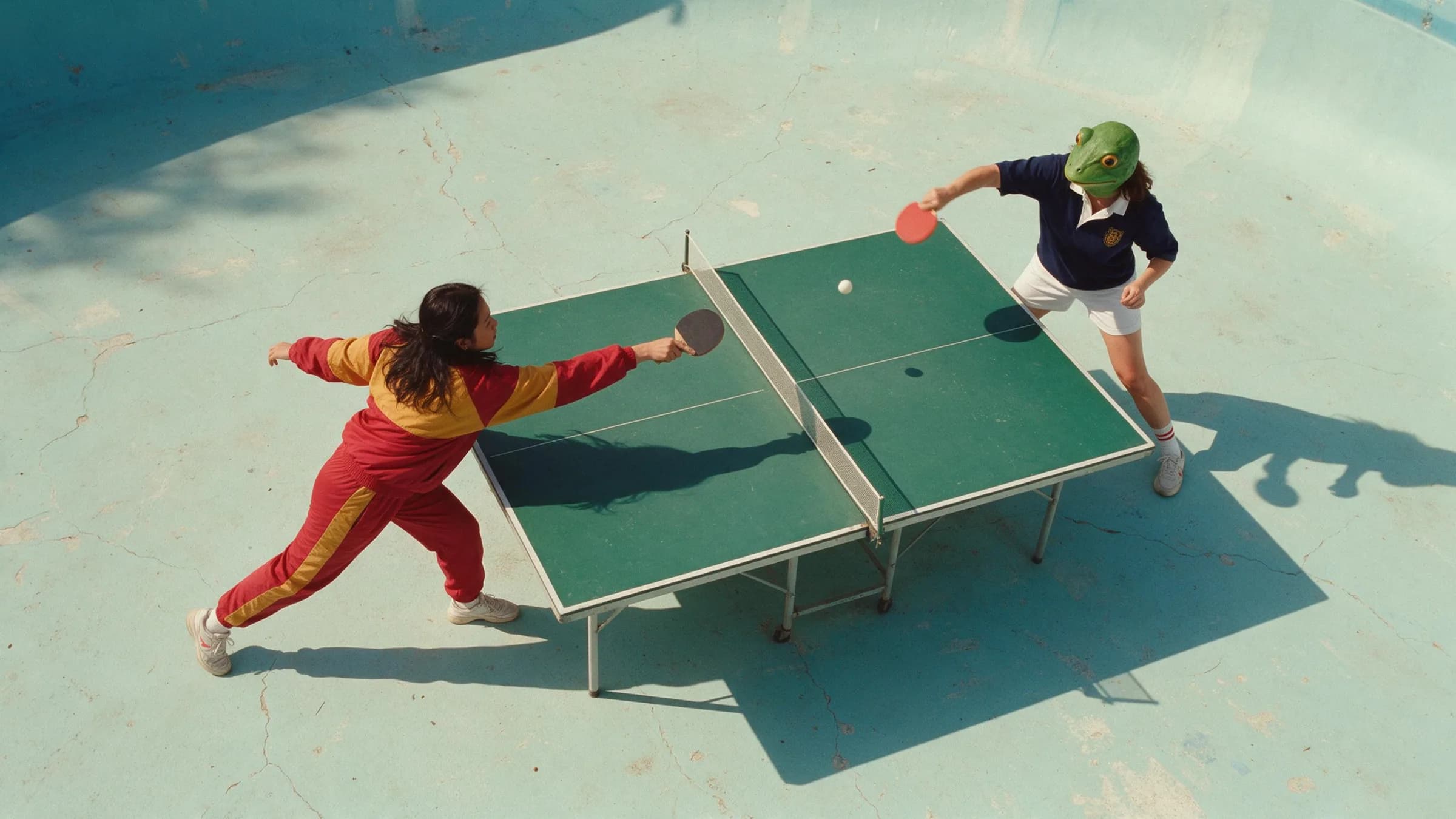
Table-tennis rally
Five scripted camera moves in a 15-second take: overhead, crane, whip pans, a 180° orbit, and a low dolly.
Input
Full prompt:
Balcony stretches
Three independently moving subjects with a continuous sequence of orbit, push-in, and vertical camera moves.
A white modernist tower with three stacked cantilevered balconies fills the right half of the frame against a pale-blue sky, in a minimal, pastel 1970s film aesthetic.
Text prompt · excerpt
Full prompt:
Farm tracking shot
A rapid lateral truck transitions into a forward dolly, followed by a close-up cut.
A vegetable farm with parallel raised beds, bamboo A-frame trellises, young tomato and bean plants, and terracotta pots under a soft overcast sky.
Text prompt · excerpt
Full prompt:
Multi-shot storytelling
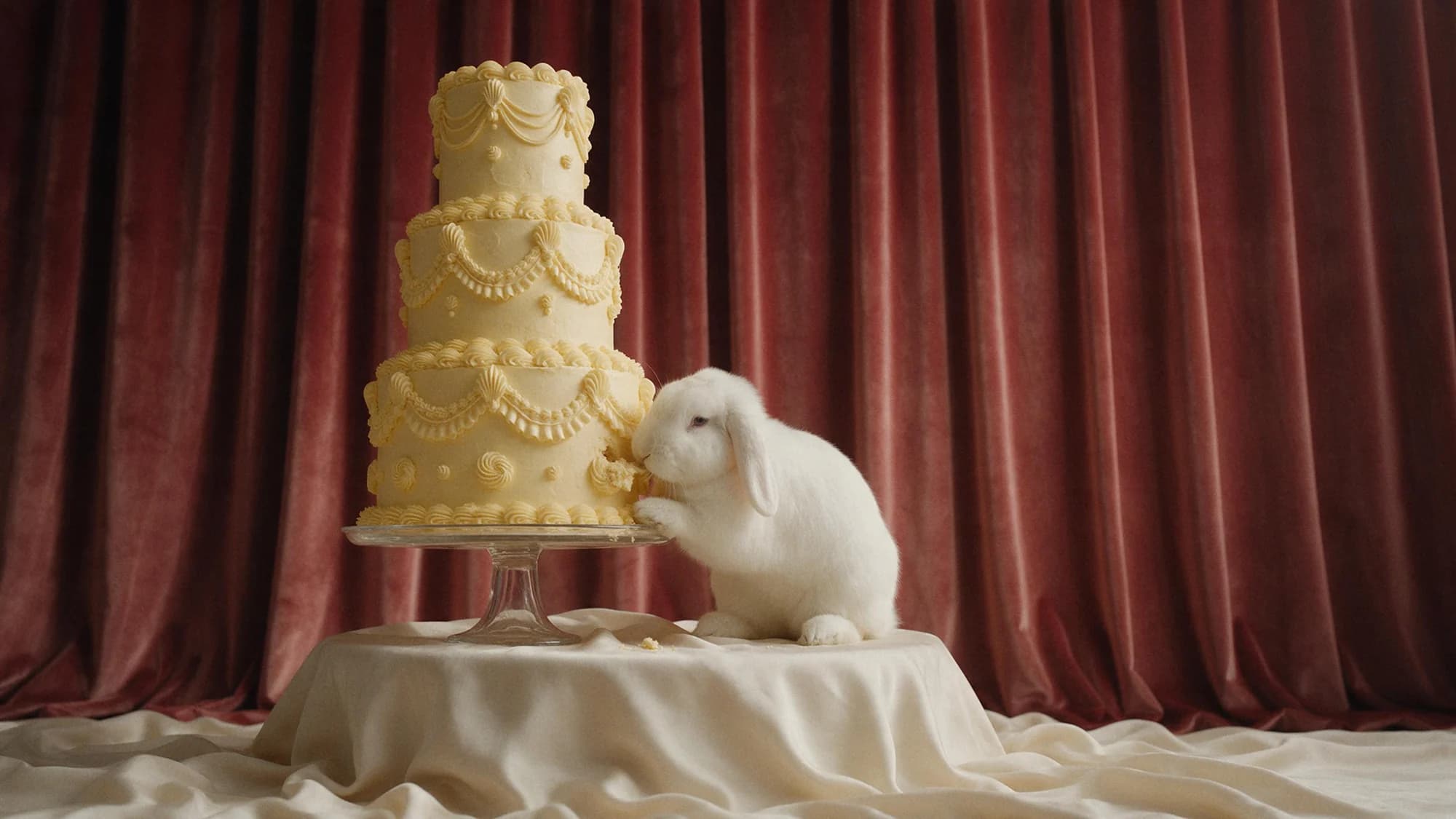
Wedding nibbler
A four-shot story directed from one image, with camera changes, dialogue, and synchronized sound.
Input
Full prompt:
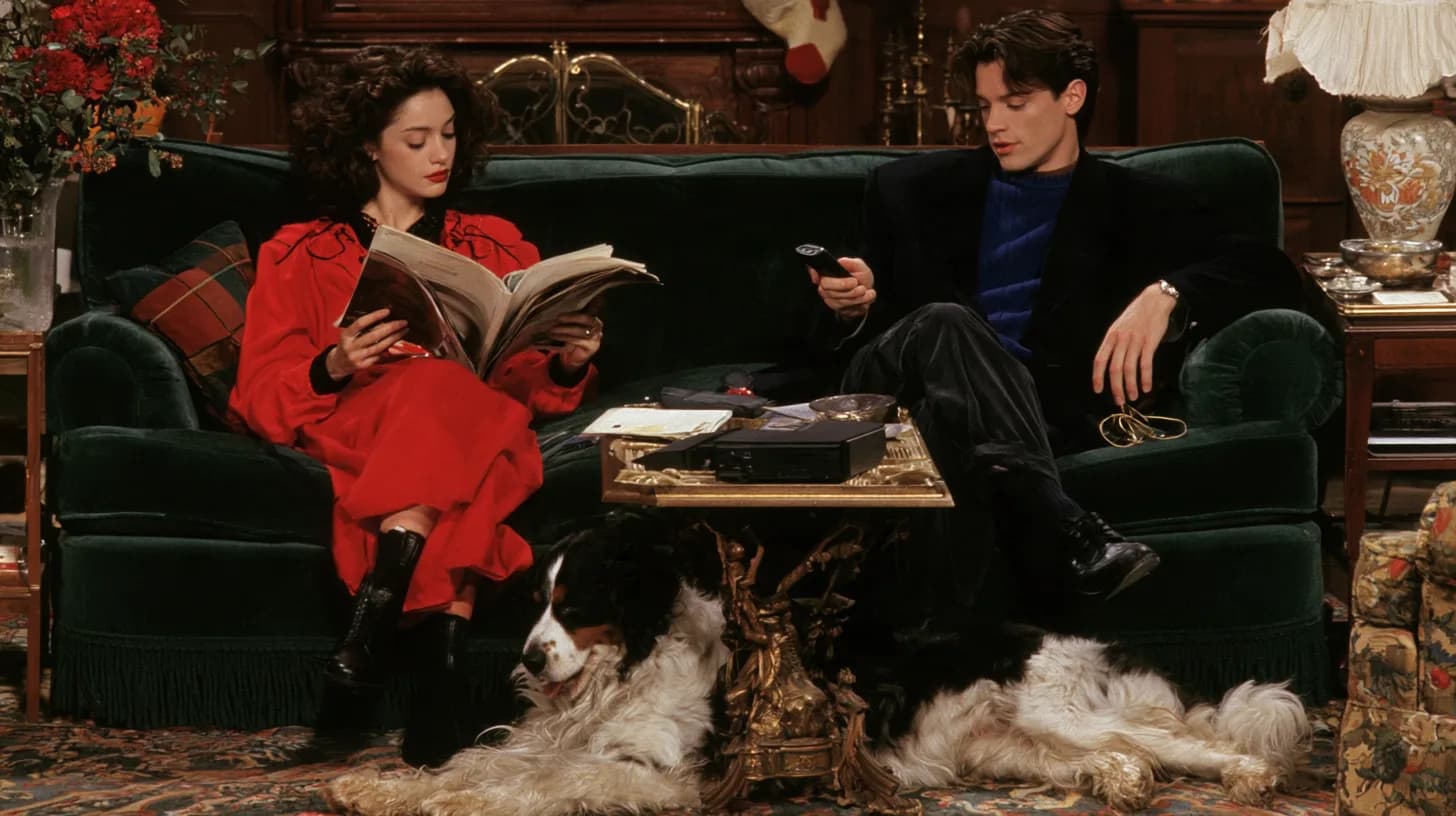
Birthday-cake sitcom
A five-shot sitcom sequence directed from one image, with dialogue, audience reactions, and sound design.
Input
Full prompt:
Motion graphics
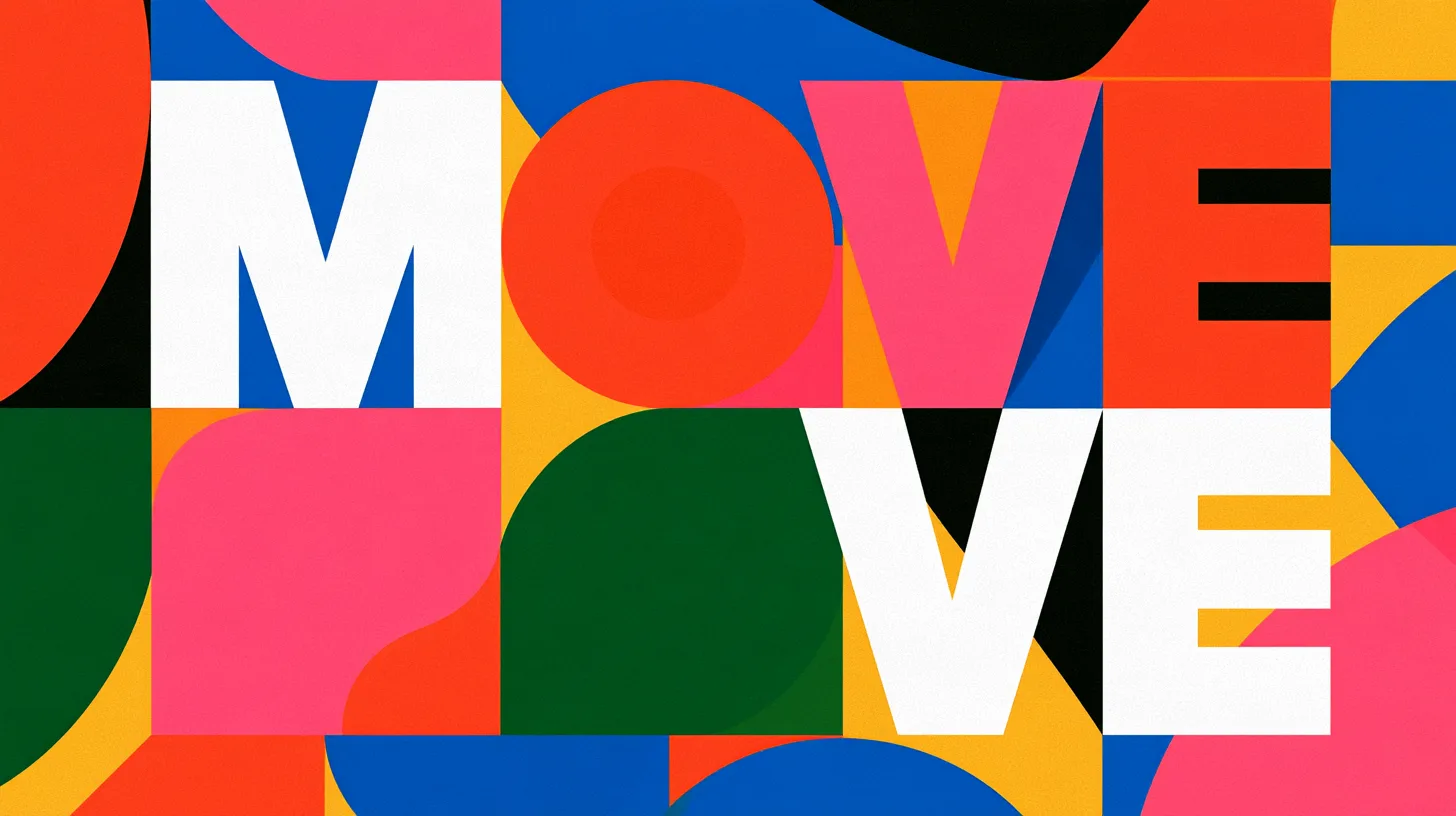
Move
A geometric design animated with beat-synced transitions and typography.
Input
Full prompt:
Sunday
A risograph poster brought to life with animated lettering, a moving character, and sound.

Input
Full prompt:
Product films
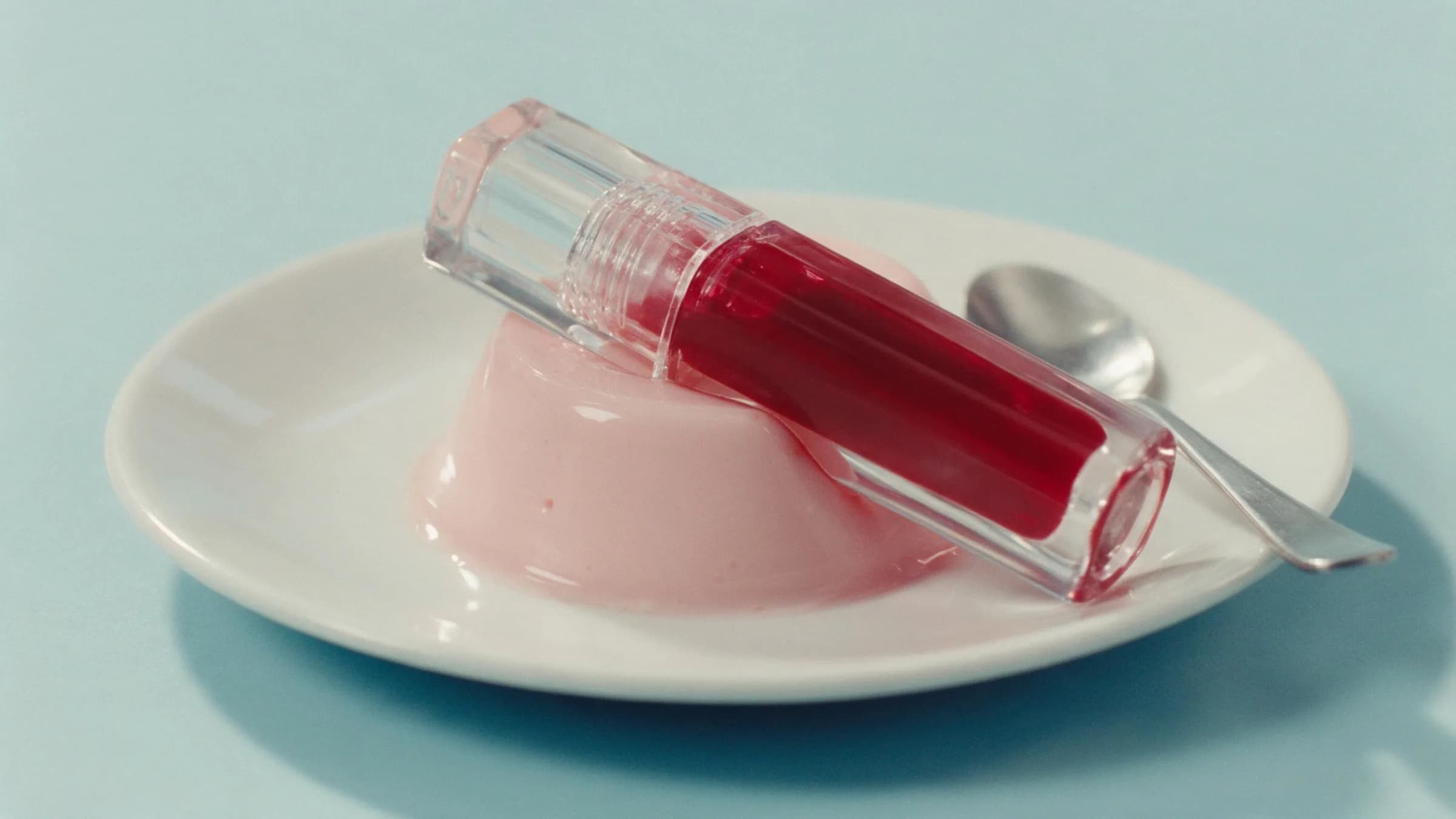
Lip gloss
A single product reference guides a multi-shot beauty commercial.
Input
Full prompt:
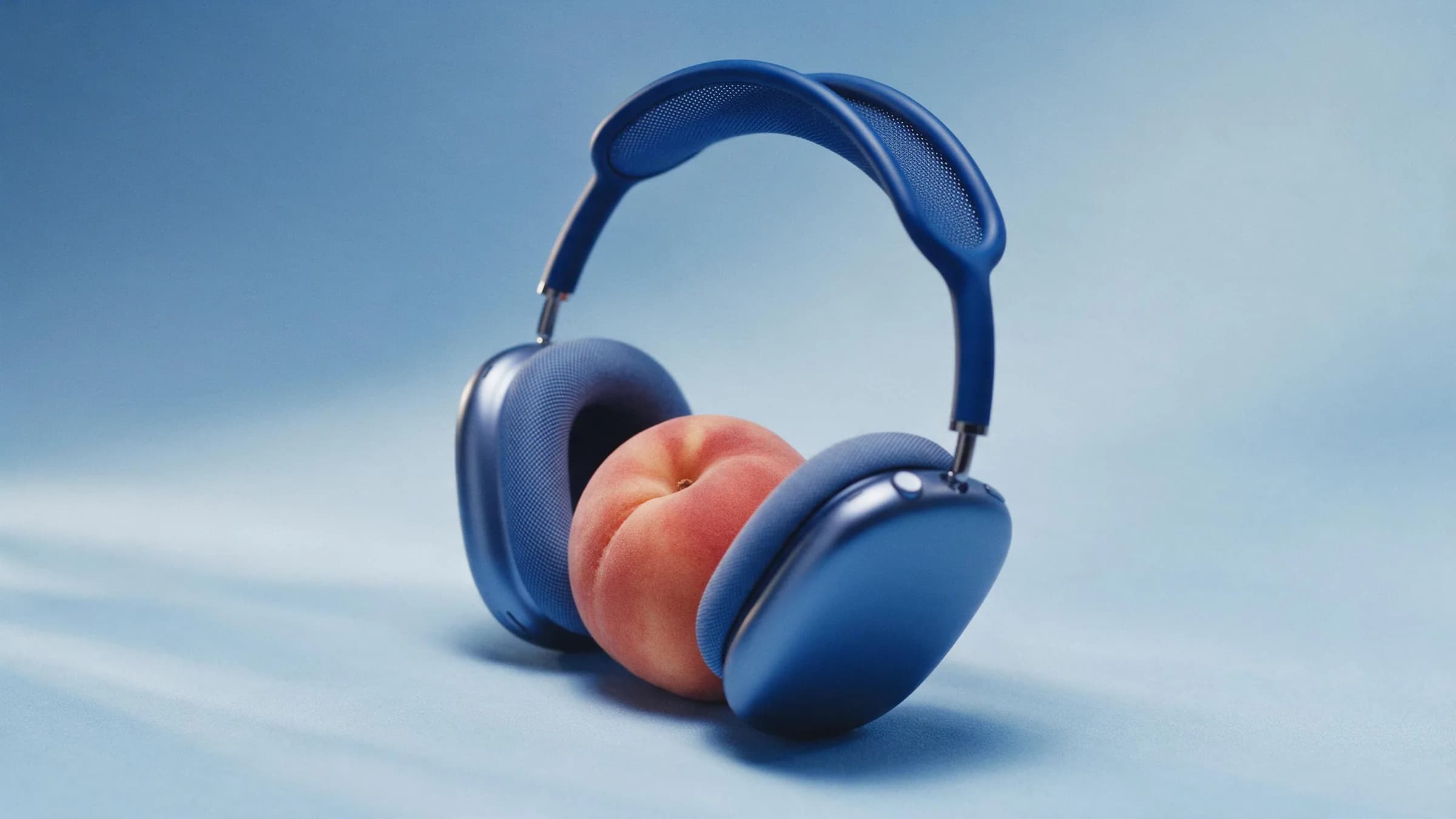
Headphones
A single product reference guides beat-synced cuts, macro details, and changing camera angles.
Input
Full prompt:
Animated shorts
Gothic wardrobe
A character and style reference guides a multi-shot animated wardrobe sequence with interface sound effects.

Input
Full prompt:
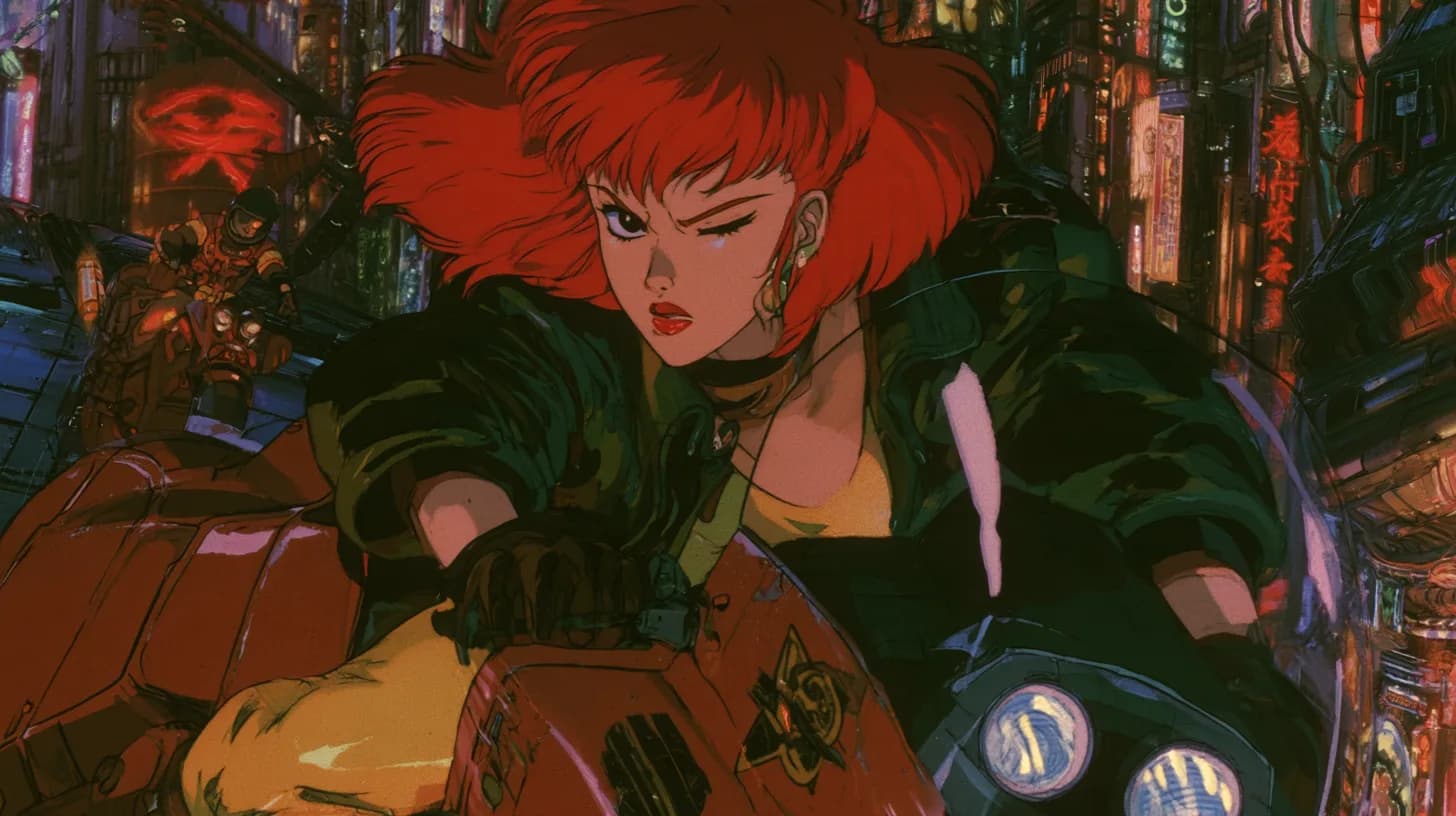
NOVA space courier
A character reference guides an eight-cut retro-anime trailer with title cards and music.
Input
Full prompt:
Composition from multiple references
Knitted game world
A game-asset overview guides characters, environments, and objects across a multi-shot sequence.
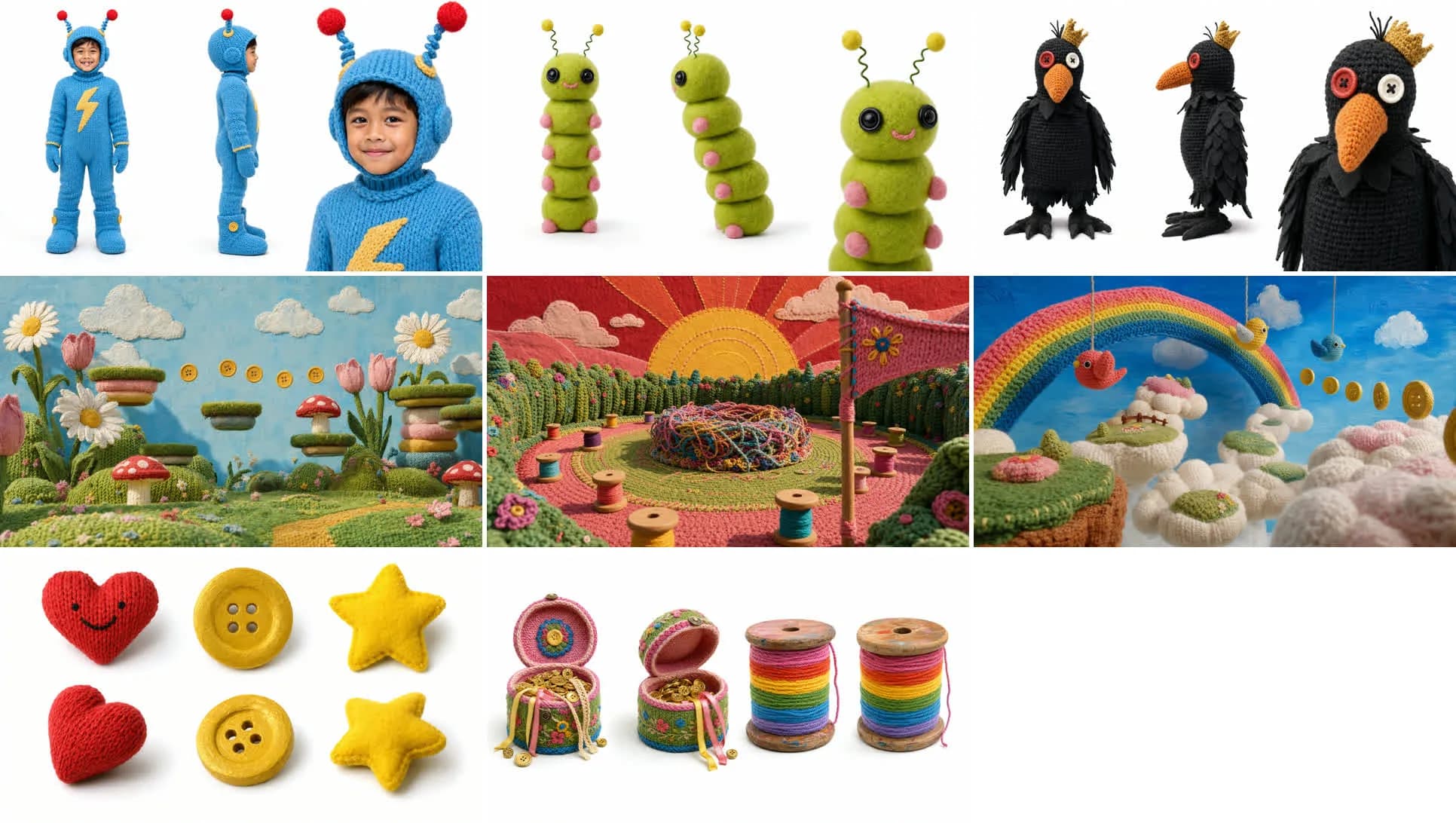
Input: 7 reference images
Full prompt:
Brutalist moodboard
A moodboard guides characters and architecture in a three-shot cinematic sequence.
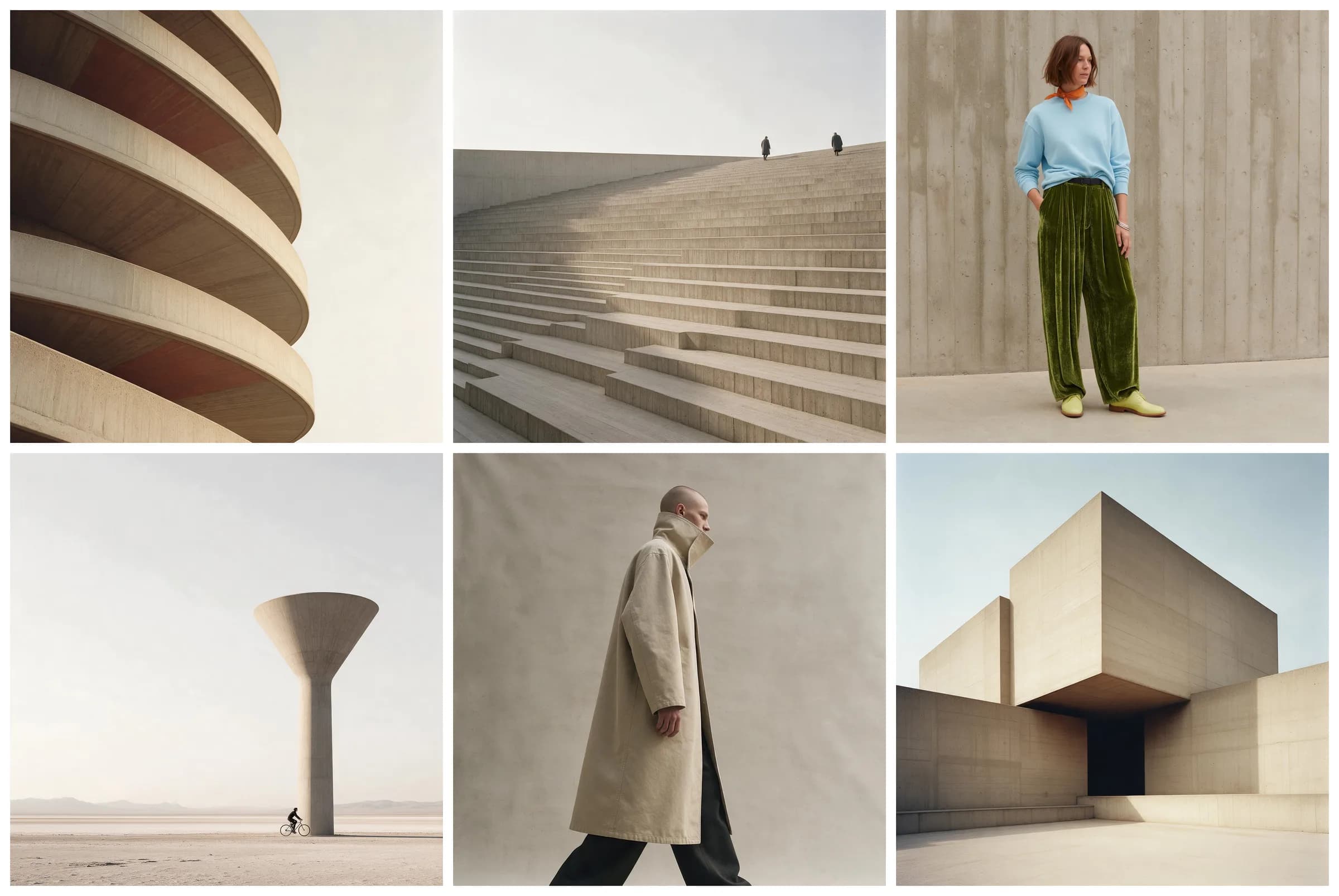
Input: 6 reference images
Full prompt:
Selective video editing
Bowling-alley transformation
Replace the environment, a ball, and background figures while preserving the foreground actor, camera, and timing.
Input
Full prompt:
Wardrobe and scene edit
Replace knitwear with cotton T-shirts and add a distant airplane while preserving the original scene and performance.
Input
Full prompt:
Motion transfer
Record-shop dance
Combine a character sheet, environment image, and motion-reference video in a stylized dance sequence.
Video reference 1
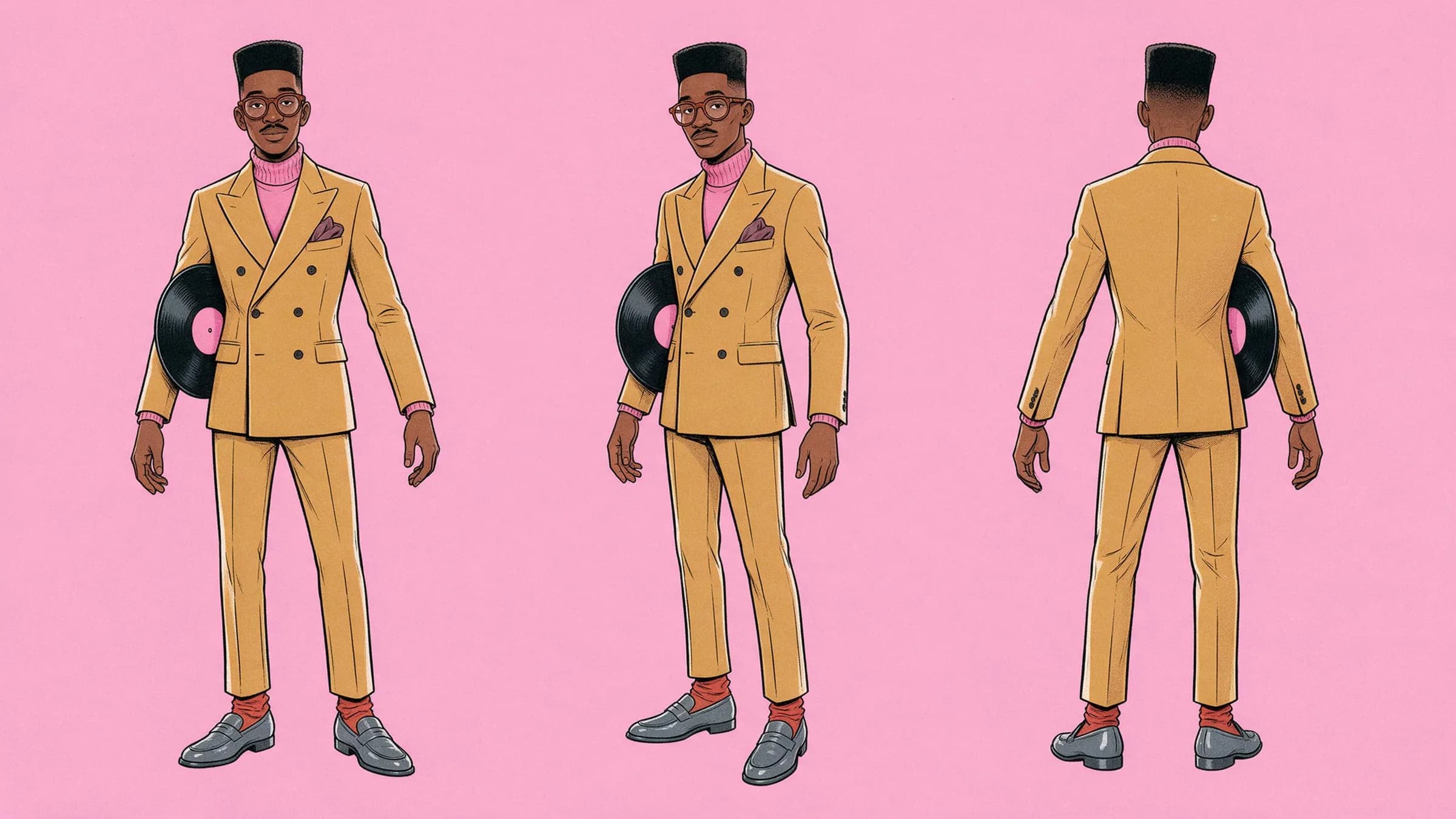
Image reference 1

Image reference 2
Full prompt:
Station choreography
Combine an opening frame, character sheet, and motion reference to direct a multi-shot dance sequence.
Video reference 1
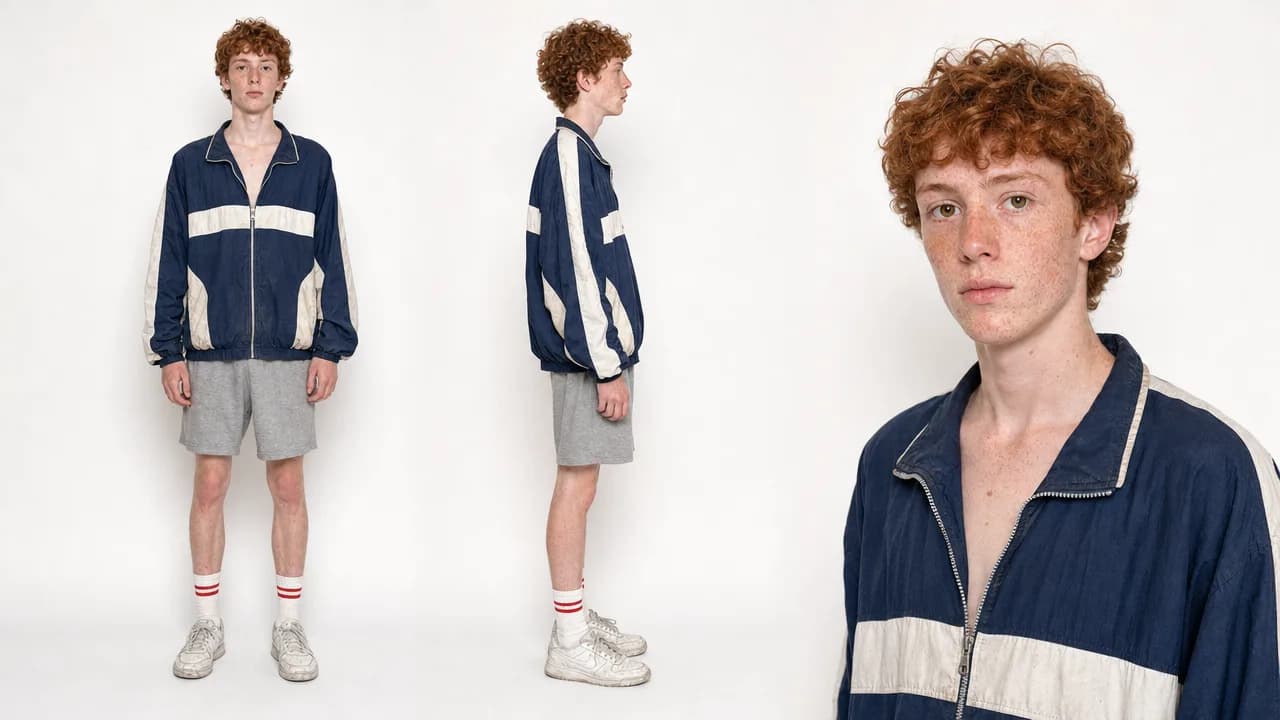
Image reference 1

Image reference 2
Full prompt:
Resolution finishing
Horse catwalk
The same 768p generation finished at 2K and 4K.
2K
4K
768p draft
Drawing-room hurdle
The same 768p generation finished at 2K and 4K.
2K
4K
768p draft
Methods
Pika H3 Flex was developed through three post-training stages: supervised fine-tuning, distribution matching distillation, and post-distillation reinforcement learning (Fig. 1).
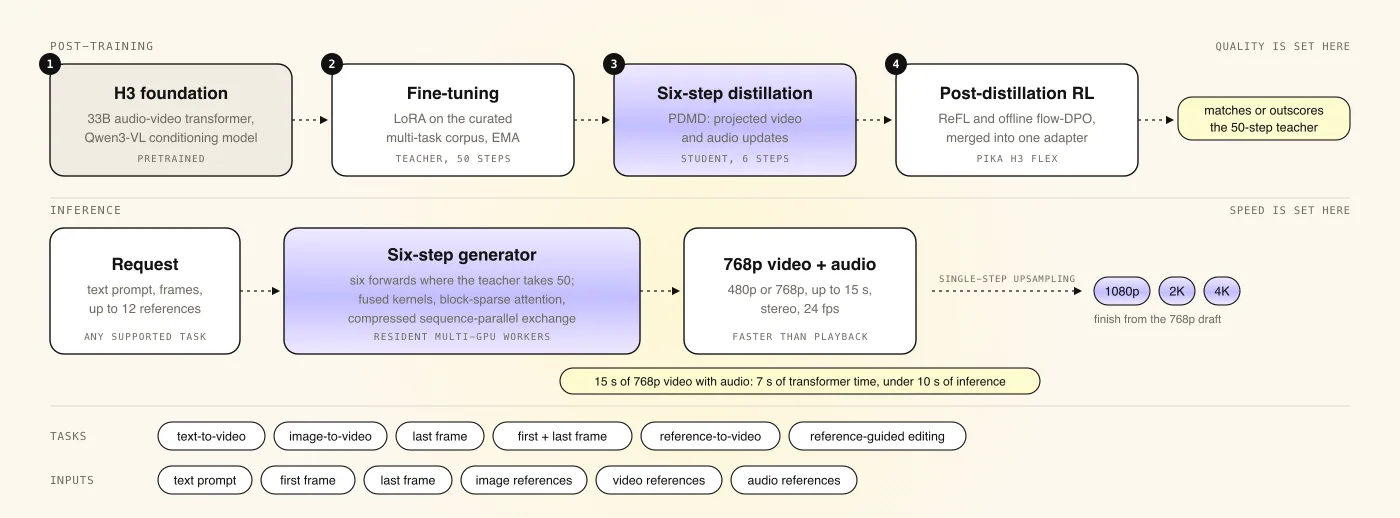
We first fine-tuned the pretrained MiniMax H3 model (MiniMax, 2026) on an in-house, aesthetically curated audio-video dataset spanning multiple generation and editing tasks. We then applied Projected Distribution Matching Distillation (PDMD; Wang et al., 2026) to reduce sampling from 50 denoising steps to six. Following distillation, we trained separate adapters using Reward Feedback Learning (ReFL; Xu et al., 2023) and Direct Preference Optimization (DPO; Wallace et al., 2024) to improve visual aesthetics, clarity, instruction following, and realism. Human pairwise preferences calibrated the automated judgments used to construct the DPO training pairs. The adapters were merged for inference without introducing additional generation steps.
The resulting model led the compared systems in our human evaluation on human anatomy, complex composition, and audio synchronization for text- and image-conditioned generation, and on visual style and framing and camera motion for reference-conditioned generation.
We further accelerated inference through fused kernels, cached timestep-dependent modulation, FlashAttention-4, block-sparse attention, and compressed communication. The optimized inference stack is served through the Pika API.
Supervised Finetuning
We performed supervised fine-tuning on a proprietary dataset curated in-house, comprising audio-video clips spanning everyday activities, performance, narrative, technical, and stylized content. For inquiries about the dataset, please contact enterprise@pika.art.
Starting from the official, guidance-distilled MiniMax H3 model (MiniMax, 2026), we fine-tuned on this dataset while retaining its 50-step sampling schedule. The resulting model exhibited improved visual style and aesthetics relative to the original model and served as the teacher for subsequent distillation.
Step Distillation
Starting from the 50-step, guidance-distilled model obtained through supervised fine-tuning, we applied Distribution Matching Distillation (DMD; Yin et al., 2024) to reduce the number of denoising steps. In our experiments, standard DMD exhibited training instability. We adopted Projected Distribution Matching Distillation (PDMD; Wang et al., 2026), which substantially improved training stability and output quality. The resulting student generates joint audio-video outputs in six denoising steps, compared with 50 for the teacher.
Post-Distillation Reward Learning
Starting from the six denoising step model, we performed post-distillation reward learning to align the model output with human preference. Specifically, we applied Reward Feedback Learning (ReFL; Xu et al., 2023) and Direct Preference Optimization (DPO; Wallace et al., 2024). ReFL targets aesthetic quality and visual clarity through differentiable reward feedback on current student outputs, while DPO learns from offline preferences covering instruction following, realism, and visual quality. We trained the two as separate low-rank adapters (LoRA; Hu et al., 2022) and merged their weights into one adapter, combining the strengths of ReFL and DPO at no added inference cost.
Inference acceleration
Starting from the post-trained six-step generator model, we cached timestep-dependent AdaLN projections and applied three groups of inference optimizations: fused kernels and packed communication, FlashAttention-4, and block-sparse attention with compressed communication. These reduce kernel overhead, attention computation, and communication costs without additional training.
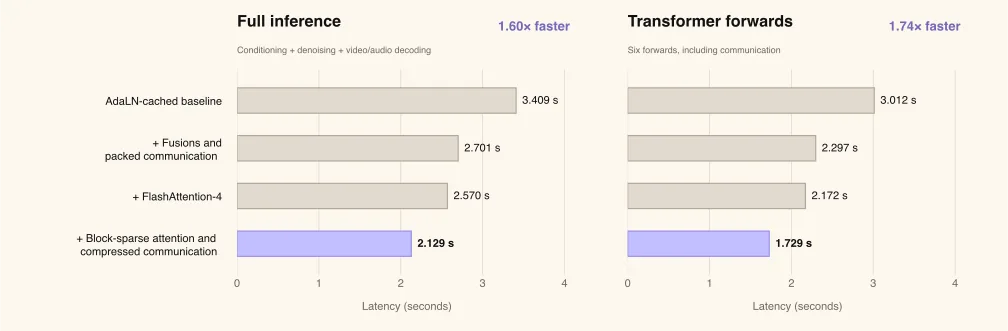
Together, these optimizations reduced full-inference latency from 3.409 to 2.129 seconds, delivering 1.60× faster full inference and 1.74× faster transformer forwards. Measurements used five-second 768p text-to-video generation with audio on eight B300 GPUs, with the checkpoint and six-step sampling schedule held fixed (Fig. 2).
Results
In this section, we benchmarked Pika H3 Flex against leading video models, including the official MiniMax H3 (model card), Fal H3 Max (fal, 2026), and HeyGen Video (quality; model documentation). Quantitative metrics and qualitative comparisons demonstrate strong performance in visual quality, aesthetics, and audio quality, with comparable or better audio-video alignment and leading human preference scores in several evaluated categories.
Quantitative Evaluation
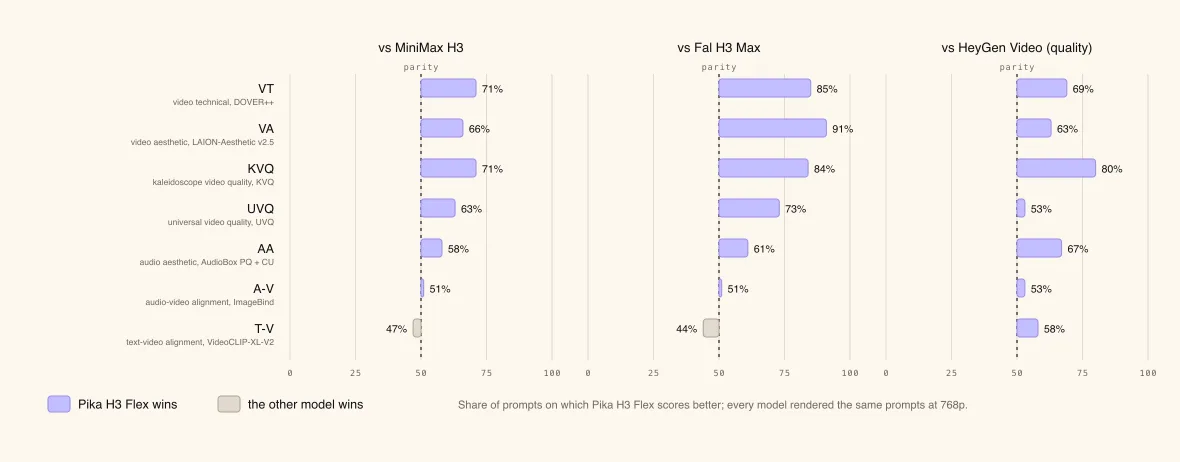
We evaluated text- and image-to-video generation against the official MiniMax H3 (model card), Fal H3 Max (fal, 2026), and HeyGen Video (quality; model documentation). All models generated outputs at 768p using the same prompt set. We assessed visual quality, audio quality, and cross-modal alignment using seven metrics, with higher scores indicating better performance:
- VT Video Technical — low-level visual integrity and technical quality (DOVER++; Wu et al., 2023).
- VA Video Aesthetic — high-level visual aesthetic quality (Aesthetic Predictor V2.5).
- KVQ Kaleidoscope Video Quality — saliency-guided local video quality assessment (Qu et al., 2025).
- UVQ Universal Video Quality — combined detail, exposure, contrast, noise, temporal-stability and color terms (Wang et al., 2021).
- AA Audio Aesthetic — equal mean of AudioBox perceptual quality (PQ) and content usefulness (CU; Tjandra et al., 2025).
- A-V Audio-Video Alignment — text-independent semantic agreement between audio and video (ImageBind; Girdhar et al., 2023).
- T-V Text-Video Alignment — semantic similarity between the video prompt and generated video, normalized to the table scale (VideoCLIP-XL-v2 model card).
Pika H3 Flex achieves the highest scores on all five visual and audio quality metrics (Table 3), outperforming each comparator on a majority of prompts for these metrics (Fig. 3). Audio-video and text-video alignment remain comparable across the four models.
Table 3. Quantitative evaluation of text- and image-to-video generation at 768p on the same prompt set. Higher is better for all metrics; bold indicates the highest score in each row. Results are from our evaluation.
| Metric | Pika H3 Flex | MiniMax H3 | Fal H3 Max | HeyGen Video (quality) |
|---|---|---|---|---|
| VT ↑ | 12.3 | 11.7 | 10.6 | 11.5 |
| VA ↑ | 5.41 | 5.28 | 5.00 | 5.33 |
| KVQ ↑ | 0.024 | 0.022 | 0.019 | 0.020 |
| UVQ ↑ | 0.602 | 0.595 | 0.590 | 0.595 |
| AA ↑ | 7.02 | 6.85 | 6.89 | 6.76 |
| A-V ↑ | 0.212 | 0.208 | 0.216 | 0.201 |
| T-V ↑ | 0.225 | 0.225 | 0.226 | 0.224 |
Qualitative Evaluation
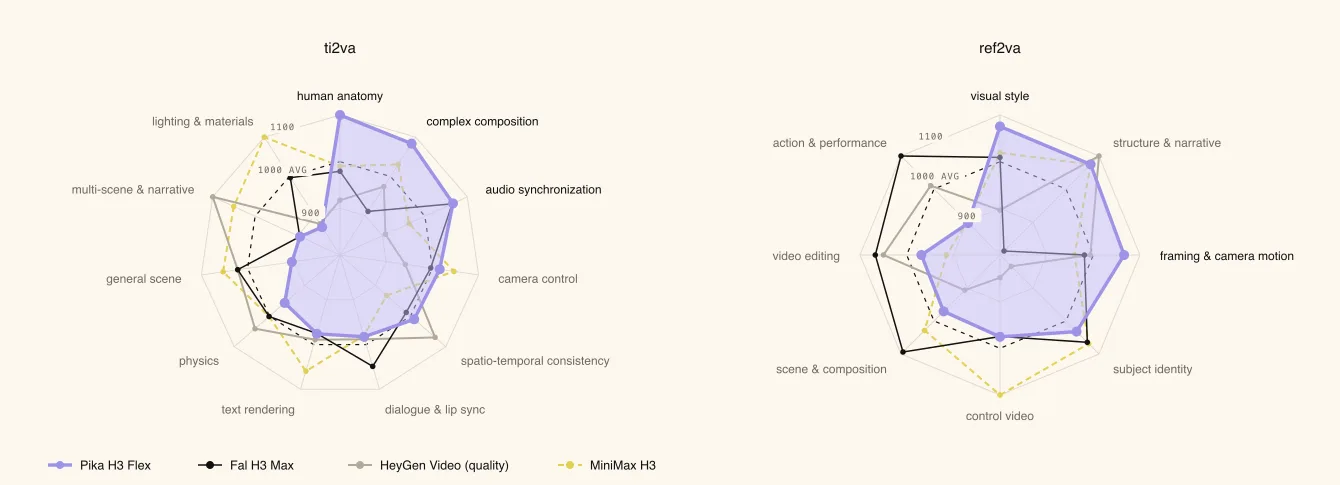
We conducted blind pairwise human preference studies against the same three models on text-, image-, and reference-to-video generation. All models rendered the same prompts at 768p. We report per-category Bradley–Terry scores on an Elo scale centered on the four evaluated models.
As shown in Fig. 4, Pika H3 Flex leads on human anatomy, complex composition, and audio synchronization for text- and image-to-video, and on visual style and framing and camera motion for reference-to-video. Other systems remain preferred in physics, multi-scene narrative, lighting and materials, and action-heavy or control-video reference tasks.
Latency
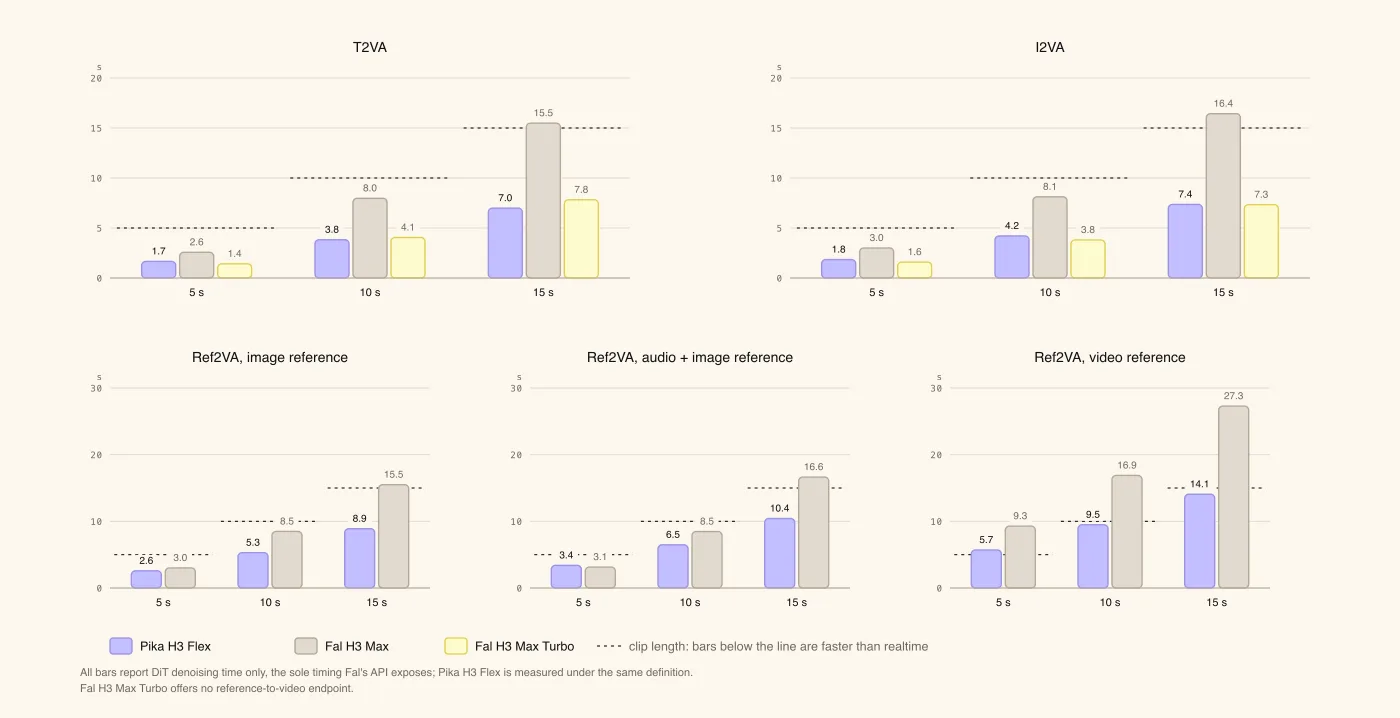
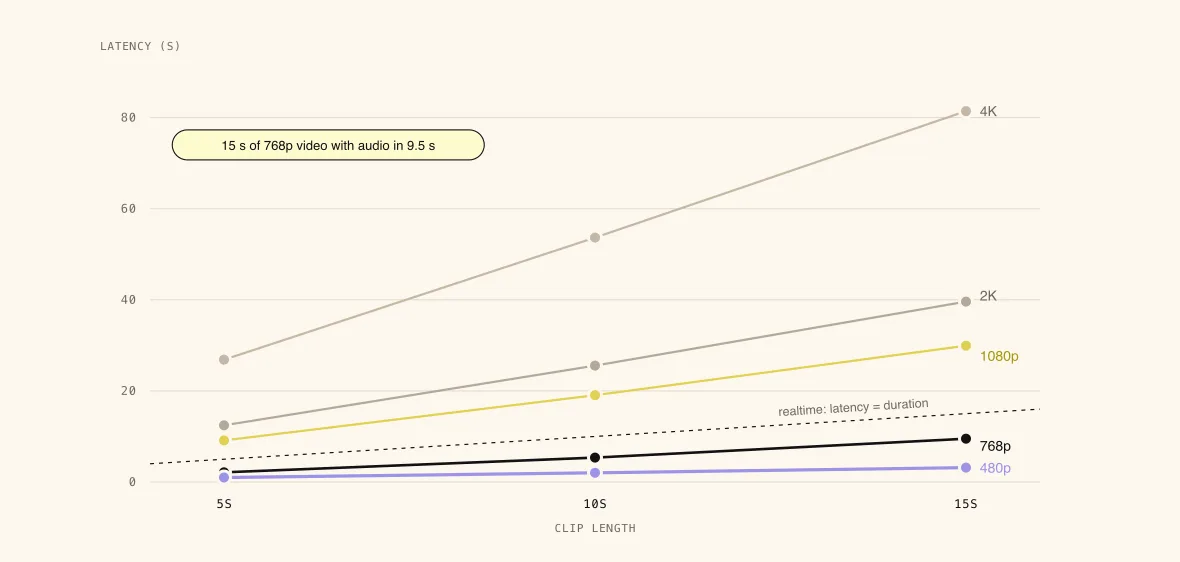
With our optimization, Pika H3 Flex achieves transformer denoising time below the generated clip duration across all evaluated configurations. At 768p, it is approximately 1.8× faster than Fal H3 Max on average across text-to-video, image-to-video, and 10-second reference-to-video comparisons.
For text/image-to-video, Pika H3 Flex is 1.5× faster than Fal H3 Max for 5-second clips and approximately 2× faster for 10- and 15-second clips, while matching Fal H3 Max Turbo. For reference-to-video, it achieves 1.3–1.7× speedups with image or image-plus-audio references for clips of at least 10 seconds, and 1.6–1.9× speedups with video references across all tested durations. Fal H3 Max Turbo does not offer a reference-to-video endpoint.
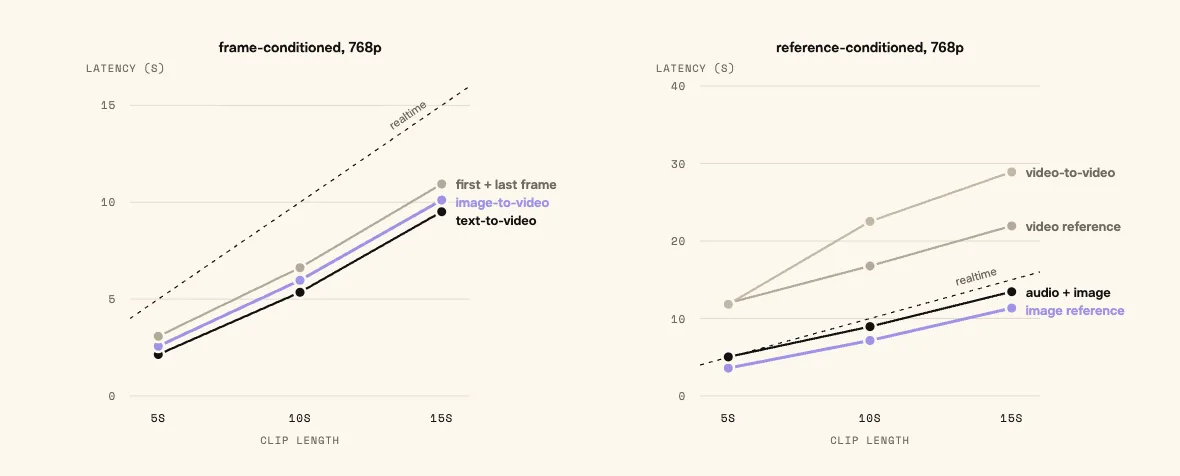
Figure 5 reports transformer denoising latency against the fal-hosted models. Figures 6 and 7 report warm inference latency by output resolution and conditioning type, respectively. Transformer comparisons exclude conditioning, decoding, and serving overhead; warm inference includes conditioning and decoding but excludes serving overhead.
Beyond the Generator: 4K Video and Audio Stems
Pika H3 Flex generates natively at 480p and 768p with synchronized stereo audio. Two finishing models extend these outputs: a single-step video upsampler for 1080p, 2K, and 4K, and a prompted audio separator for editable stems. Both operate within the same request without modifying the generator.
Video Upsampling
Our in-house upsampler is a 1B-parameter transformer that operates directly in pixel space, producing upscaled frames in a single network evaluation. Causal processing with a frame cache keeps memory independent of clip length, while block-sparse attention scales linearly with pixel count.
We trained the model from scratch on high-quality footage, including native 4K video, using synthetic degradations to construct low-resolution inputs. Reconstruction, adversarial, and reward objectives improved detail and temporal consistency while preserving composition, identity, motion, and color. The model supports scale factors from 1× to 4×, with deterministic output independent of batching and request order (see Fig. 8).
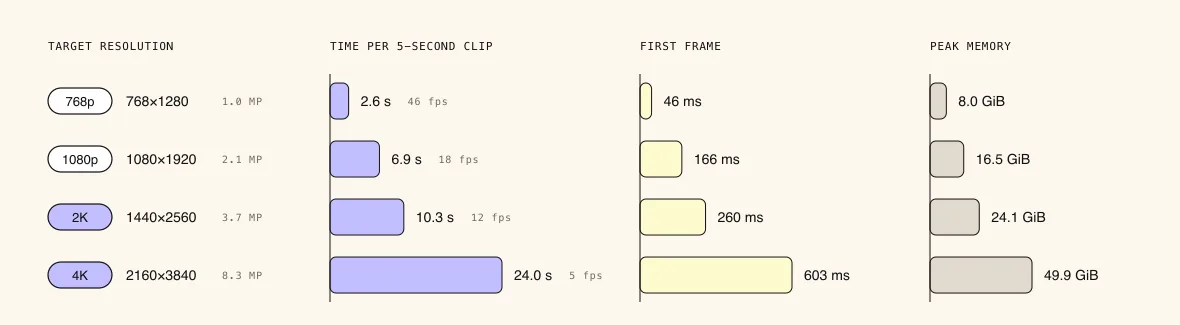
On a single GPU, the first 1080p frame is available after 0.17 seconds (see Fig. 9). Processing time scales linearly with clip length. We will opensource the upsampler model.
Audio Stem Separation
The generator jointly produces speech, music, effects, and ambience as one synchronized soundtrack. We apply prompted source separation to recover five editable stems: dialogue, score, SFX, foley, and ambience.
This approach preserves the generator’s audio objective and avoids requiring stem-labeled video for training. The stems are returned alongside the unchanged video and mixed soundtrack, enabling independent audio editing in post-production.
Conclusion
We introduced Pika H3 Flex, an open-weight model family for joint video and audio generation built through supervised fine-tuning, six-step distribution matching distillation, and reward and preference alignment. Combined with an optimized inference stack, Flex reduces generation from 50 to six denoising steps while improving measured visual and audio quality relative to the evaluated models, with comparable cross-modal alignment.
Flex supports text-, frame-, and reference-conditioned generation and editing, with up to 4K finishing and five editable audio stems. These capabilities enable rapid creative iteration across generation, motion transfer, and targeted video edits. Physics, multi-scene consistency, and complex reference control remain areas for further improvement. We release the model weights and code to support further research and development.
Access
Pika H3 Flex is available through our API, ComfyUI, and Diffusers, with model weights available on Hugging Face and code on GitHub. Explore the Pika API. Pika also offers customized training services. For inquiries, contact enterprise@pika.art.
References
- MiniMax. MiniMax H3. Model card, 2026. Hugging Face.
- Yin, T., et al. One-step Diffusion with Distribution Matching Distillation. CVPR, 2024. Paper.
- Wang, Z., et al. PDMD: Projected Distribution Matching Distillation for Video Diffusion Models. 2026. Paper · Project page.
- Xu, J., et al. ImageReward: Learning and Evaluating Human Preferences for Text-to-Image Generation. NeurIPS, 2023. Introduces Reward Feedback Learning (ReFL). Paper.
- Wallace, B., et al. Diffusion Model Alignment Using Direct Preference Optimization. CVPR, 2024. Paper.
- fal. Introducing H3 Max by fal. 2026. Model announcement.
- HeyGen. HeyGen Video. Official model and API documentation. Documentation.
- Wu, H., et al. Exploring Video Quality Assessment on User Generated Contents from Aesthetic and Technical Perspectives. ICCV, 2023. DOVER and DOVER++. Paper · Code.
- discus0434. Aesthetic Predictor V2.5: SigLIP-based Aesthetic Score Predictor. Code and model information.
- Qu, Y., et al. KVQ: Boosting Video Quality Assessment via Saliency-guided Local Perception. CVPR, 2025. Paper.
- Wang, Y., et al. Rich Features for Perceptual Quality Assessment of UGC Videos. CVPR, 2021. Universal Video Quality (UVQ). Paper · Code and model checkpoints.
- Tjandra, A., et al. Meta Audiobox Aesthetics: Unified Automatic Quality Assessment for Speech, Music, and Sound. 2025. Paper.
- Girdhar, R., et al. ImageBind: One Embedding Space To Bind Them All. CVPR, 2023. Paper.
- Alibaba PAI. VideoCLIP-XL-v2. Model card and checkpoints. Hugging Face.
- Hu, E. J., et al. LoRA: Low-Rank Adaptation of Large Language Models. ICLR, 2022. Paper.
Cite this work
@misc{pika2026flex,
  title  = {Pika H3 Flex Technical Deep Dive},
  author = {{Pika Research}},
  year   = {2026},
  howpublished = {\url{https://pika.art/blog/pika-h3-flex-research}}
}